The Story in Brief

“Agentic AI is less a breakthrough solution and more a forcing function that exposes long-standing metadata, ownership, and governance gaps. What stands out is how AI reframes familiar data quality and metadata issues as urgent and unavoidable. Topics that once struggled to gain traction are now top of mind because agents make the consequences of poor foundations immediately visible.”
Picking Up the Story
Agentic AI is Stalling at the Enterprise Level
Many enterprises are experimenting with agentic or AI-driven approaches to automate workflows and connect data across systems. But early experiments are revealing how dependent these efforts are on foundational data infrastructure.
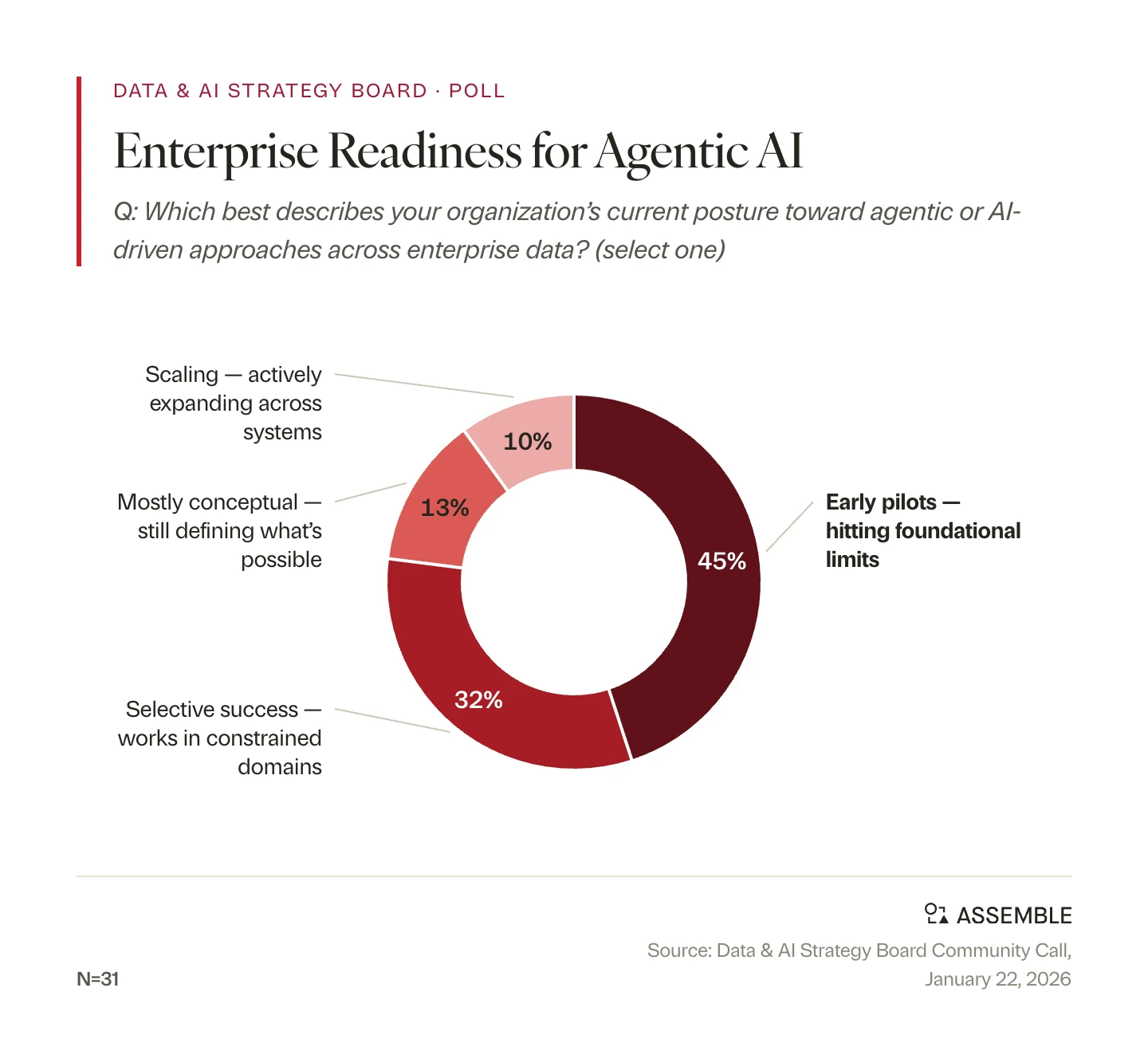
45% of members note that their organization is running early pilots that are already hitting foundational limits. Also, only 10% of organizations are actively scaling.
“We see good use cases where the data is actually curated and there’s strong governance, and failures where there wasn’t a clear steward.”
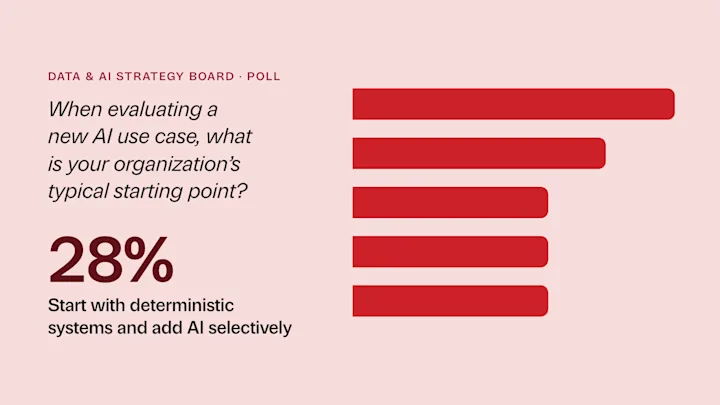
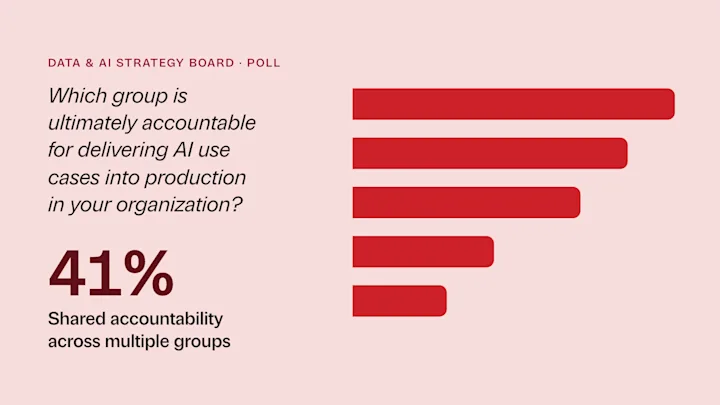
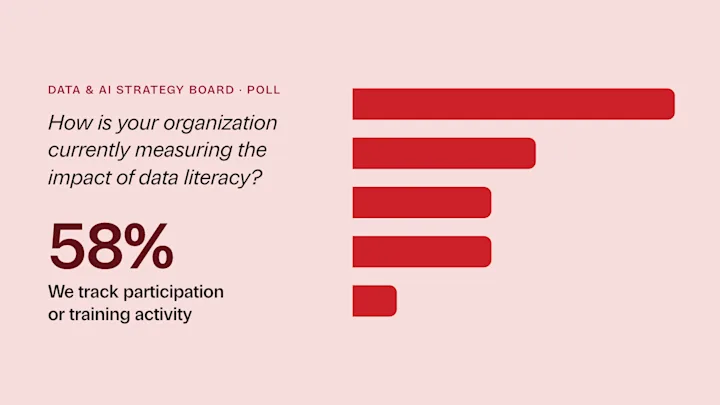
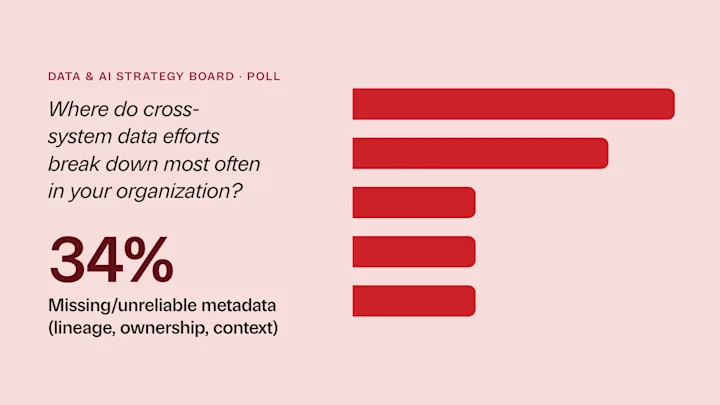
Poll results
Focus of the Discussion
AI Agents Are Exposing Your Metadata Problem
Agentic AI is a catalyst that’s exposing weaknesses in enterprise data environments.
Early pilots have shown promise in narrow use cases, but scaling these systems across organizations remains difficult. One of the most consistent challenges involves metadata. Missing lineage, unclear ownership, and incomplete documentation make it difficult for agents to interpret data reliably. As one participant explained, “Context begins to be solutioned via metadata.” Without that context, agents struggle to navigate across systems or produce trustworthy outputs.
Key Takeaways
Gaps in metadata, ownership, and governance existed prior to AI, but were easier to work around in traditional analytics. Agentic use cases often made the consequences of weak foundations more visible and immediate.
Most organizations are finding early agentic pilots work only in narrow, well-curated domains, and stall at enterprise boundaries. Poll results and discussion showed many teams achieving selective success where data is already governed, stewarded, and trusted. Members described a practical “tipping point” where agents function locally, but cannot scale across domains.
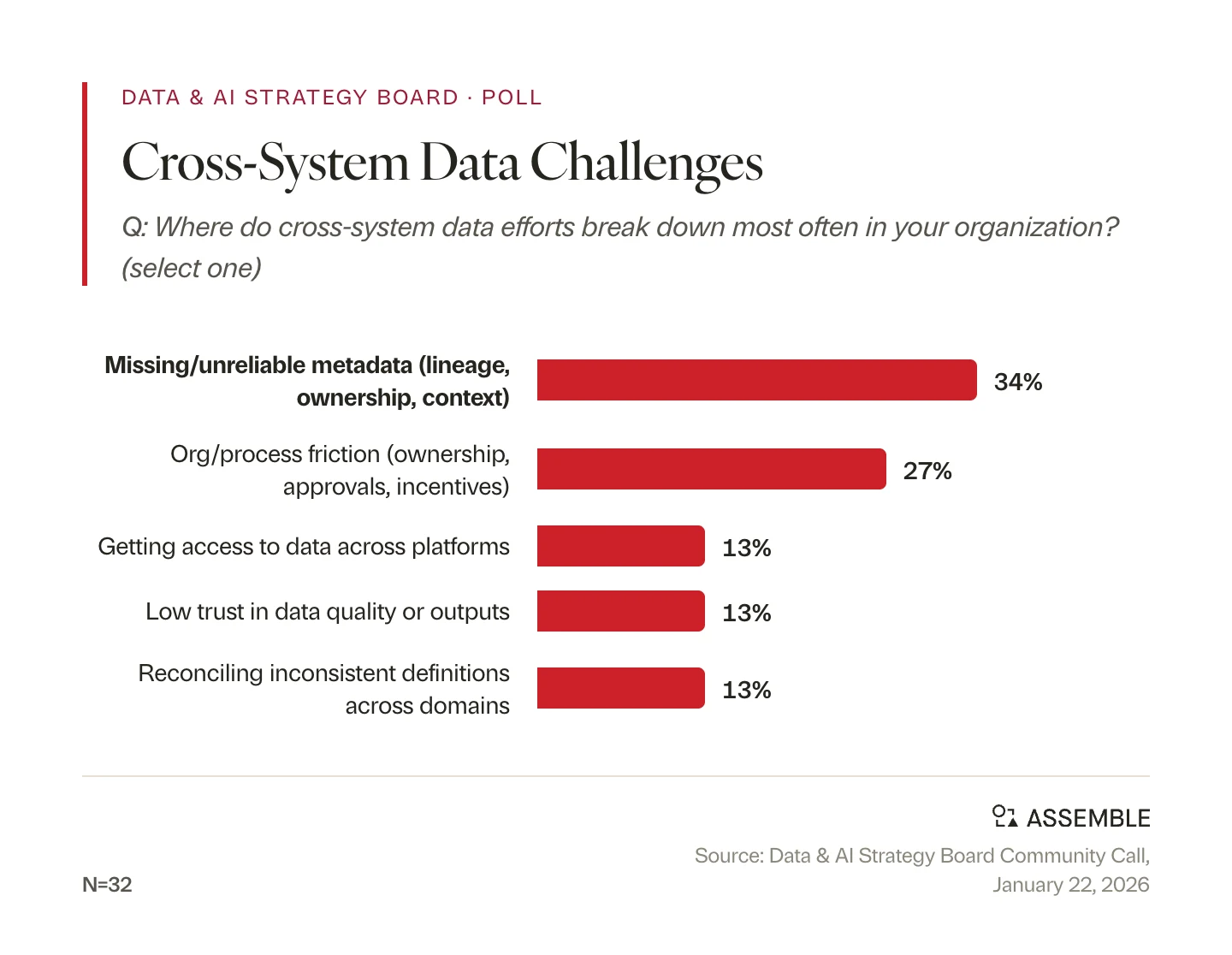
Missing or unreliable metadata was cited as the most common point of breakdown in cross-system data efforts. Several members emphasized that master data alone is insufficient without shared semantics that give data meaning across domains. Inconsistent definitions were described as a frequent cause of misleading or unusable agent outputs.
Members pointed to approvals, unclear accountability, and risk posture as limiting factors for agent autonomy. Regulated and risk-averse environments described the need for strict guardrails and human-in-the-loop controls. Many challenges initially framed as “AI limitations” were traced back to process and ownership design.
Several participants shared their belief that a single, universal enterprise agent is unrealistic at this stage. Those participants favored multiple domain- or task-specific agents operating within clearly bounded contexts. Concerns about long-tail scenarios and unintended behavior reinforced skepticism toward fully generalized agents.
About the Data & AI Strategy Board and Assemble
The Data & AI Strategy Board is an Assemble community that helps senior data, analytics, governance, and AI leaders at the world's largest companies make better, faster decisions through trusted peer insights.
We selectively share highlights from confidential member conversations to help leaders understand how peers are navigating complex challenges and fast-moving, high-stakes moments.
If you'd like to learn more about the conversations happening inside our peer network, or how members connect with trusted peers to solve critical challenges, please contact us.