The Story in Brief

“What’s emerging is not a single model for AI ownership, but a consistent lack of one. Most organizations are distributing accountability across various teams, with very few relying on a centralized function. That shift is helping teams move faster, but it’s also making it harder to maintain visibility, alignment, and control, especially as ‘shadow AI’ begins to surface outside formal processes.”
Picking Up the Story
The Shift to Decentralized AI
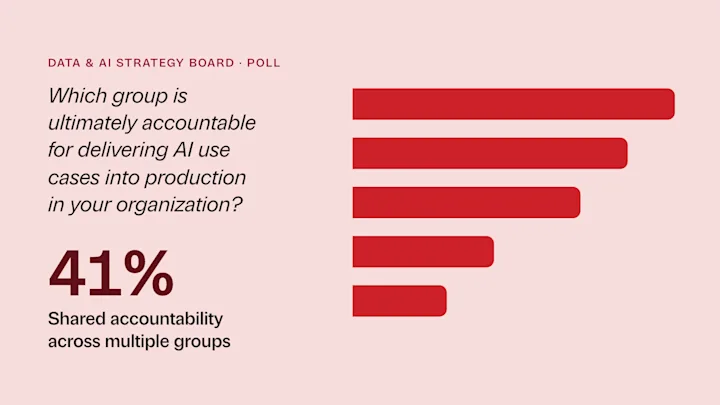
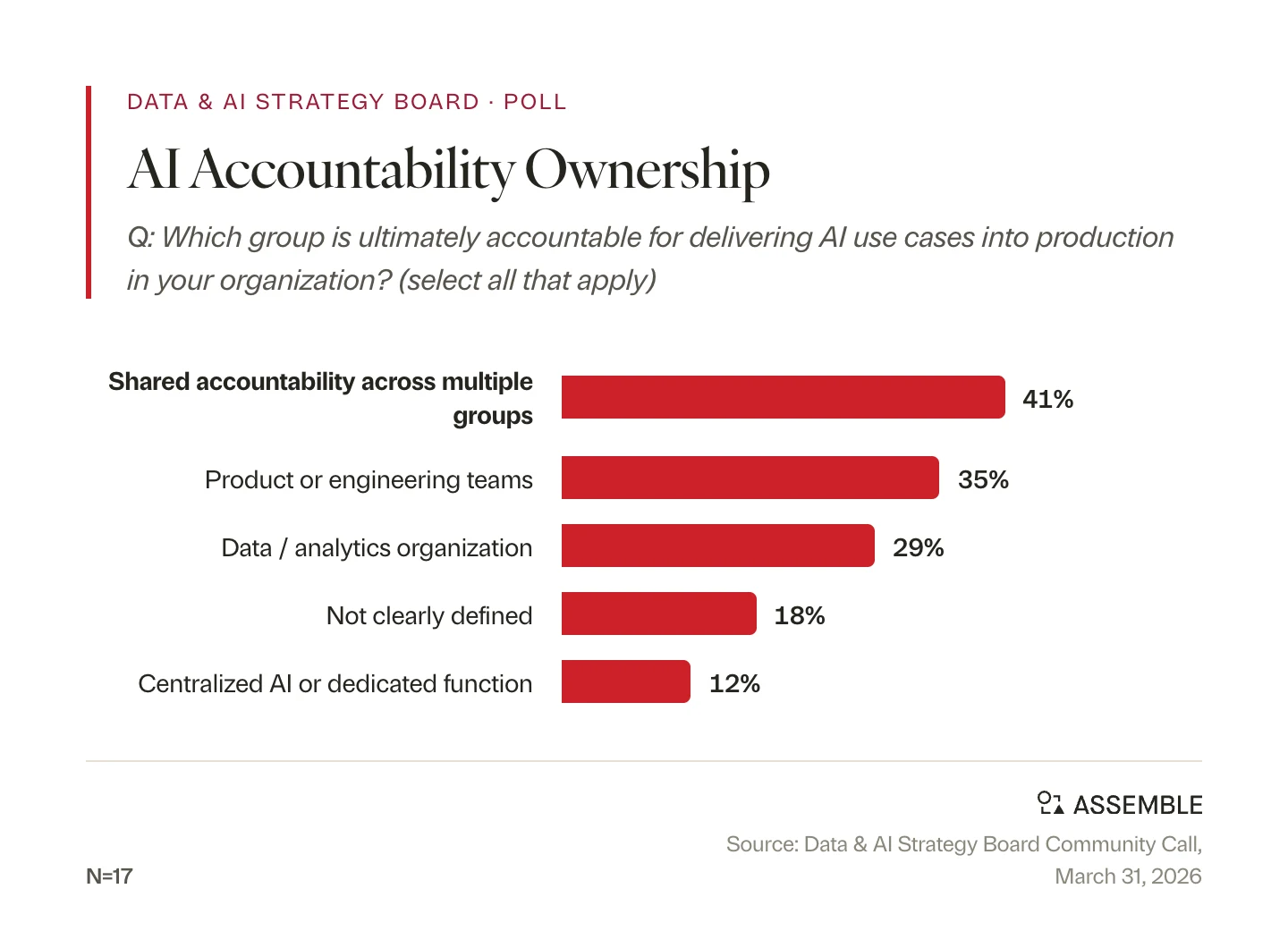
As AI adoption accelerates, organizations are moving quickly to operationalize use cases, but ownership remains fragmented. Only 12% of organizations report having a centralized AI function, while 41% say accountability is shared across multiple groups, and 18% say it’s not clearly defined at all.
In practice, that means most companies are building AI without a single point of control.
“We have a Gen AI Council, and every new use case is supposed to go through it.”
Poll results
Focus of the Discussion
AI is Scaling Faster Than Its Governed
AI is being built across organizations, but not always in alignment.
Product and business-aligned teams are responsible for building and deploying AI use cases, while centralized data and AI groups provide platforms, standards, and guardrails. This model is improving speed and relevance; but without tight coordination, organizations risk duplication, inconsistent standards, and fragmented efforts. Compounding the issue is the rise of “shadow AI.” As access to tools expands, teams are building solutions outside formal processes, often due to lack of awareness or friction in governance.
The result is a system under tension: Organizations are trying to move quickly with decentralized teams, while maintaining control through layered governance.
Key Takeaways
Shared accountability is emerging as a practical reality for some teams, even as formal ownership models remain fluid. Several members described overlapping responsibilities depending on the use case, domain, or stage of development. Some leaders noted that this flexibility can be useful, though it also requires clearer alignment mechanisms over time.
Lightweight governance approaches are helping many teams maintain visibility without slowing experimentation. Rather than relying on heavy approval processes, many organizations are introducing simple but structured ways to track and review AI activity. Examples included use case registration, GenAI councils, and principle-based approvals that move quickly when guardrails are met. These approaches were often described as creating awareness rather than acting as strict control points.
Embedding data and AI resources into business teams, along with structured connection points, is helping organizations stay aligned as work becomes more distributed. Several members described embedding data or AI engineers into business units, particularly where there is high activity, to act as a conduit for new initiatives. Others highlighted the role of roadmap-sharing forums and internal communication (e.g., roadshows) to ensure that teams are aware of available capabilities and planned investments.
Organizations are taking different approaches to governance and oversight, as they work to balance speed with appropriate controls. Members described a range of review structures, including architecture, legal, risk, and privacy processes, with some requiring multiple approvals before moving into production. In several cases, these reviews are introduced early, even before proofs of concept, while others embed them within broader delivery processes.
About the Data & AI Strategy Board and Assemble
The Data & AI Strategy Board is an Assemble community that helps senior data, analytics, governance, and AI leaders at the world's largest companies make better, faster decisions through trusted peer insights.
We selectively share highlights from confidential member conversations to help leaders understand how peers are navigating complex challenges and fast-moving, high-stakes moments.
If you'd like to learn more about the conversations happening inside our peer network, or how members connect with trusted peers to solve critical challenges, please contact us.