The Story in Brief

“What stood out wasn’t friction — it was how much stronger these relationships already are than many leaders assume. But most of that collaboration is still being driven by EX, and outcomes vary widely depending on how engaged HRBPs are. The shift now is toward earlier involvement, clearer ownership, and real co-creation — because that’s where teams are starting to see more consistent impact.”
Picking Up the Story
More Aligned Than Expected — But Not Yet Operationalized
Heading into the discussion, many expected to hear about friction between EX and HRBPs. Instead, leaders described something more encouraging — and more complex. Collaboration is happening, and in many cases, it’s working.
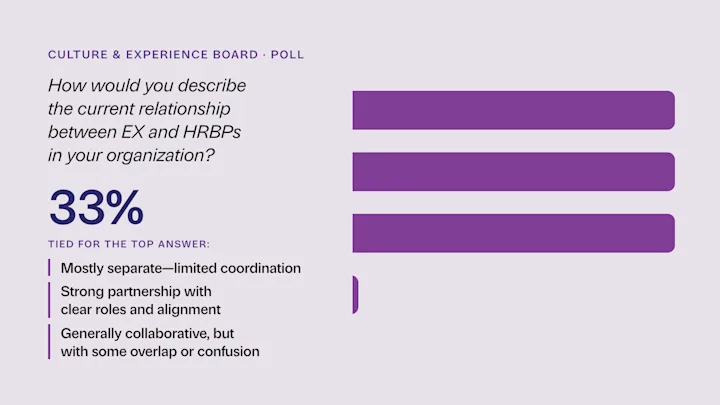
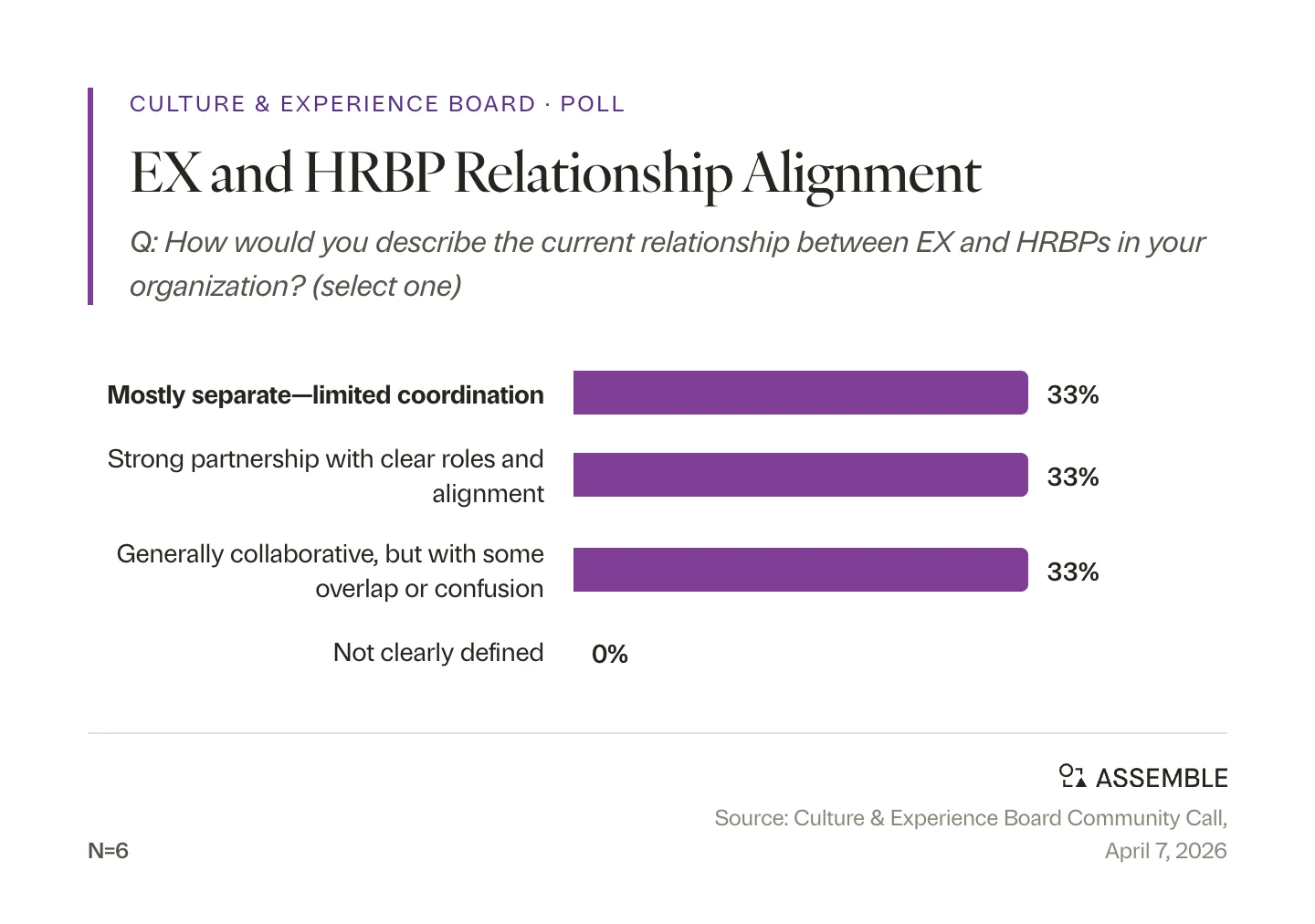
But it’s not yet operationalized. Poll responses showed an even distribution across partnership models, and members repeatedly pointed to variability in how HRBPs engage, how work is shared, and how ownership is defined. That variability makes it difficult to scale impact — even when the intent to collaborate is strong.
“You have to be in alignment — and someone has to get there to create that alignment.”
Poll results
Focus of the Discussion
Enablement Is Emerging as the Lever — But Not a Consistent One
In response, some teams are shifting their approach — not by pulling back, but by leaning further in. Instead of owning programs end-to-end, they’re focusing on enabling HRBPs to carry the work forward. One leader noted that when they made HRBP enablement a top priority, everything was better: their work was better, and the impact was stronger.
Tactically, this is showing up in more structured touchpoints, shared planning, and clearer alignment to business priorities. But even here, progress is uneven. Outcomes still depend heavily on how actively HRBPs engage, and in many organizations, ownership remains blurred — particularly in areas like professional development. As one member put it, “Friction #1 is who owns professional development and what that looks like.”
The result is a model in transition: from collaboration to co-creation, from support to shared ownership — that is just starting to scale.
Key Takeaways
Many EX and HRBP relationships are stronger than expected, creating a foundation to build on. Leaders described active collaboration and mutual reliance, with poll results reflecting a mix of strong partnership, partial collaboration, and more separated models. Even where gaps exist, there is a shared recognition that closer alignment improves outcomes.
Bringing HRBPs into planning earlier is helping EX work better reflect business context and land more effectively. In several cases, routing work through HRBPs improved organizational resonance and began shifting EX away from program delivery toward enabling execution. Impact still varies based on HRBP engagement.
EX teams are still driving most relationships, but some are beginning to shift toward more balanced partnership. Members described EX leading outreach and engagement, particularly outside structured cycles, while also creating more space for HRBPs to share signals and shape work earlier.
Structured touchpoints and enablement are helping build trust and consistency, but outcomes remain uneven. Regular cadences, office hours, and shared planning are making it easier to stay aligned and support HRBPs in carrying work forward, though variability persists across teams.
Clarifying ownership across EX and HRBP domains is a key unlock for reducing friction. Areas like employee listening, onboarding, and professional development still feel shared or unclear, but explicit role definition tied to business priorities is improving accountability and execution.
About the Culture & Experience Board and Assemble
The Culture & Experience Board is an Assemble community that helps senior culture, workforce experience, and organizational change leaders at the world's largest organizations make better, faster decisions through trusted peer insights.
We selectively share highlights from confidential member conversations to help leaders understand how peers are navigating complex workforce challenges and emerging opportunities.
If you'd like to learn more about the conversations happening inside our peer network, or how members connect with trusted peers to solve critical challenges, please contact us.