The Story in Brief

“Organizations are moving faster with agentic AI than expected. This isn't just experimentation — it's beginning to influence workforce planning, hiring, and how work itself is structured.”
Picking Up the Story
Moving Fast, Thinking Slowly
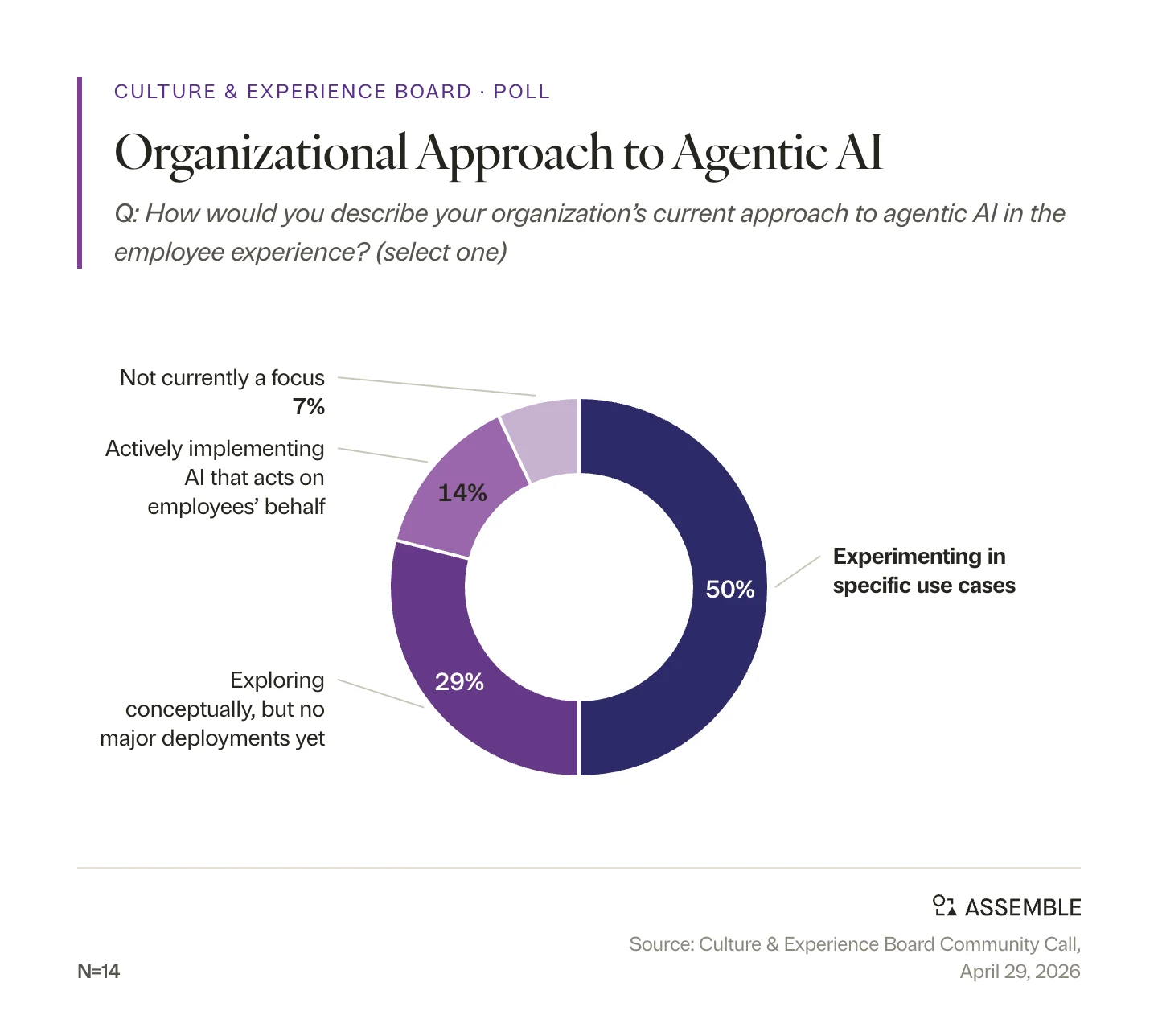
While 29% of members say they’re exploring agentic AI, 64% have implemented or are experimenting with the technology in the form of pilots or other limited releases. They largely reported being further along in their agentic journeys than expected, with many pilots and live deployments in place, and a profound effect on workforce planning.
The speed of adoption is creating some challenges and risks. Companies may run afoul of labor laws or other standards if hiring, performance management, or promotion have algorithmically automated steps. Some organizations, enamored by the capabilities of agents, say they’ve stopped hiring early-career employees. They’re telling employees that all of their jobs are going to look different.
Moreover, input from the talent-strategy lens has been difficult to insert into a prolonged process that already includes legal, risk, and IT. They don’t want to prolong it; but it’s also been a challenge to get strategic around AI investments.
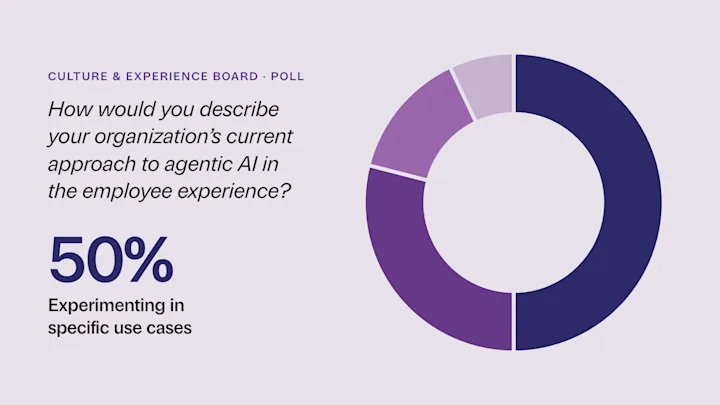
Charts: Current Approach to Agentic AI in the Employee Experience
Question: How would you describe your organization’s current approach to agentic AI in the employee experience?
Type: Single select
Experimenting in specific use cases (e.g., HR service delivery, workflows): 50%
Exploring conceptually, but no major deployments yet: 29%
Actively implementing AI that can take action on behalf of employees: 14%
Not currently a focus: 7%
Total N: 14
“We're heavily recruiting in the senior space because junior-level roles will go away, but at some point, experience will run out." — Recommended. The most forward-looking, consequential quote in the document. Names a decision being made now and a risk that hasn't been resolved. Specific enough to be credible; carries real forward pull. Pairs with all three headline options. "We're telling people your work is going to be completely different five years from now, and we don't know what it's going to look like." — Strong on honesty and organizational candor. Works well if the editorial team wants the employee/human perspective to anchor the piece rather than the hiring and governance tension. "We have an AI governance committee — HR, info security, tech — but it feels like we get sidetracked and haven't had a chance to be strategic about what we don't want AI to do." — Precise articulation of the governance gap. Best paired with Option A or C headline if the Focus leans harder into the governance thread. "We need more focus on data quality. The agents can be amazing, but the data needs to be clean and organized." — Grounding and widely applicable. Use as a counterweight to the workforce planning signal — reminds readers there are foundational prerequisites before the high-stakes decisions matter.”
Poll results
Focus of the Discussion
Agentic AI Upends Workforce Planning
Members reported that workforce planning is quickly evolving thanks to AI capabilities. Job descriptions and org charts need to be rewritten, and some companies are reducing or eliminating early-career hiring on the assumption that agentic AI can absorb that work. Others are using AI tools to help assess workforce needs.
HR has been ripe for automation given the library of rules that govern its processes and the disparate systems often required for employees to access their benefits or payroll information. Internal chatbots, virtual assistants, and platforms to create unified front-end experiences across HR and IT systems have been a popular use of emerging technology.
Governance has not kept up with the speed of adoption, however. Formal AI risk assessments through legal, compliance, and IT are taking three to four months. Several members noted that governance committees have gotten better at reviewing AI’s legal risks but often struggle to weigh the business value against the risks.
Key Takeaways
Embed agentic AI across existing systems. Members described a shift towards integrated, employee-facing workflows, such as internal chatbots, virtual assistants, and "Ask AI" layers that aggregate different tools into a single front-end experience. Rather than introducing entirely new systems, multiple members described embedding AI into existing infrastructure to make the employee experience more seamless.
Get HR into the AI governance process. Members described lengthy risk assessment processes that involve legal, compliance, and IT, but HR needs to be there too. Members report wide variance in their governance models.
Draw the line. Organizations are still actively working out where agentic AI should and should not have autonomy in the employee experience. Lower-risk use cases like answering questions or initiating requests are more broadly accepted; higher-stakes decisions such as performance-related actions are seen as off-limits.
New paradigms for workforce planning. Agentic AI is influencing workforce planning decisions, particularly around early-career hiring and role design. This shift is creating tension around internal mobility and long-term talent pipelines.
Redesign work with a focus on enhancement. AI is beginning to reshape how work gets done. Many describe a shift toward higher-value, more complex work. Some members are paying close attention to how increased reliance on AI might affect skill development, and several organizations are investing in more structured capability-building efforts, including AI champion networks and skills assessments.
About the Culture & Experience Board and Assemble
The Culture & Experience Board is an Assemble community that helps senior culture, workforce experience, and organizational change leaders at the world's largest organizations make better, faster decisions through trusted peer insights.
We selectively share highlights from confidential member conversations to help leaders understand how peers are navigating complex workforce challenges and emerging opportunities.
If you'd like to learn more about the conversations happening inside our peer network, or how members connect with trusted peers to solve critical challenges, please contact us.