The Story in Brief

“I hope this is the first of many ‘small teams’ calls. I’m consistently amazed at the perseverance and willpower of leaders who are carrying the load for their enterprise’s social media approach, especially when the team might be only one or two people! This conversation gave us a chance to talk about everything from the x’s and o’s of short-form video and using AI (or not) to more personal issues like learning how to say “no” and find the awareness we need not just as social media leaders, but as human beings. We’ll do this again soon!”
Picking Up the Story
Enterprise Expectations, Small-Team Resources
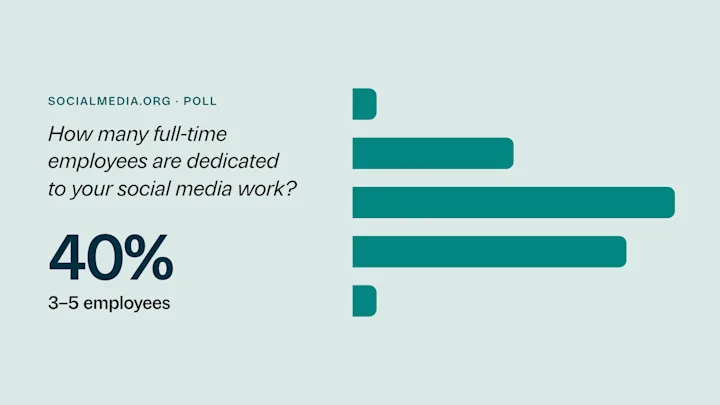
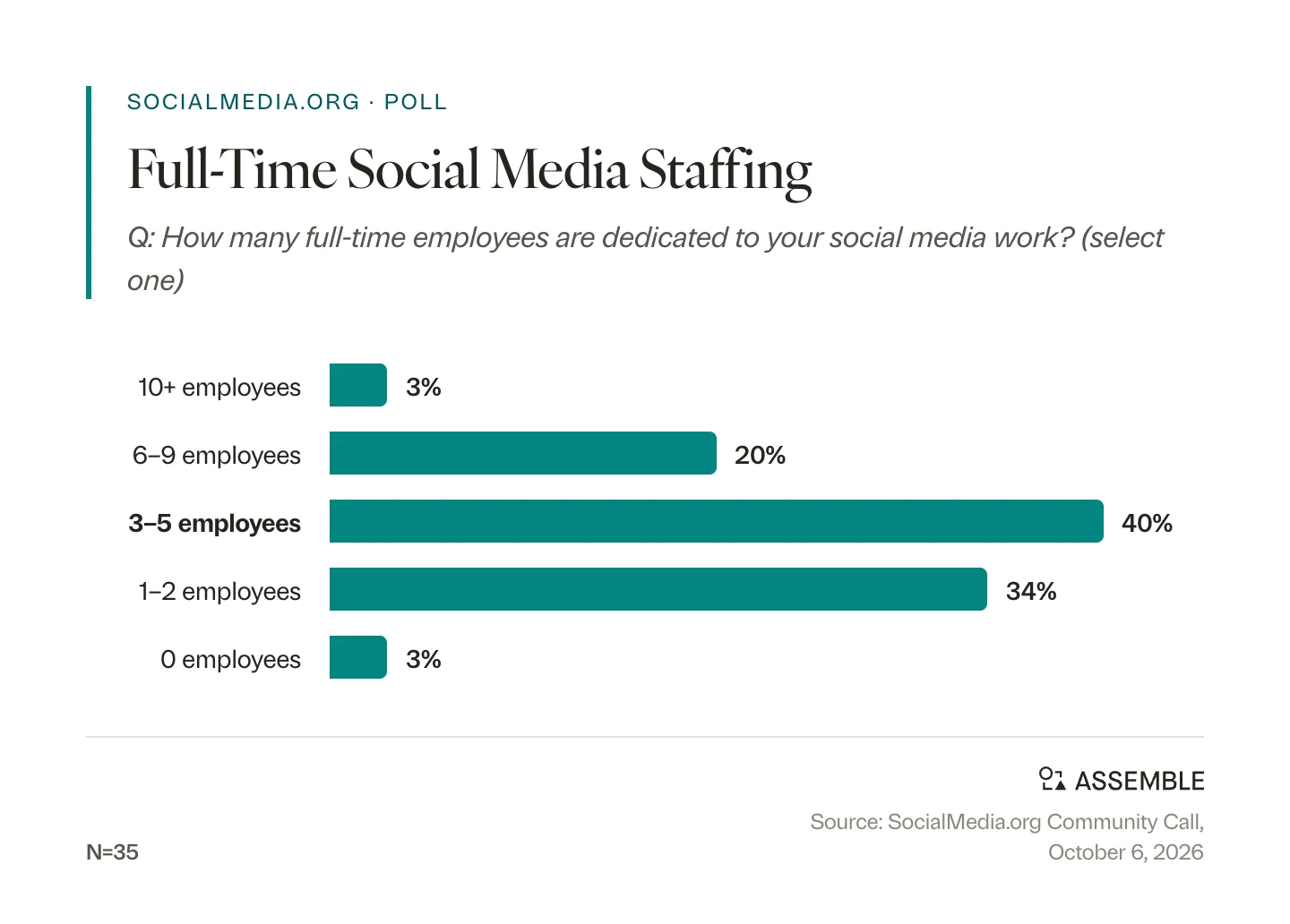
At some of the world's largest companies, entire social media operations rest on one or two dedicated employees. In a member poll, 34% reported having just one or two full-time social media employees, while another 40% had three to five. Yet these teams oversee everything from organic and paid channels to employee advocacy, reputation management, reporting, and growing demands for social-first video.
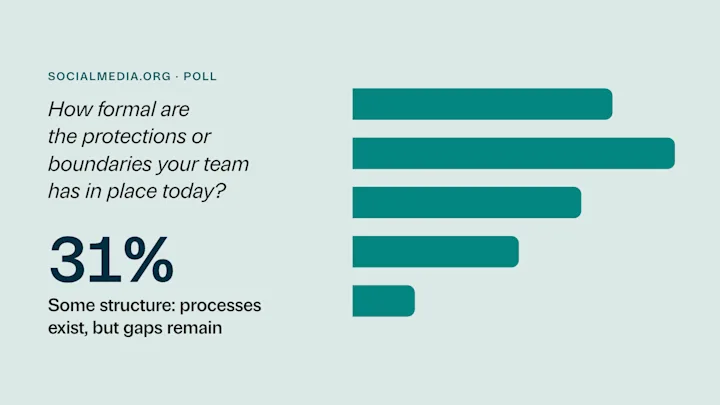
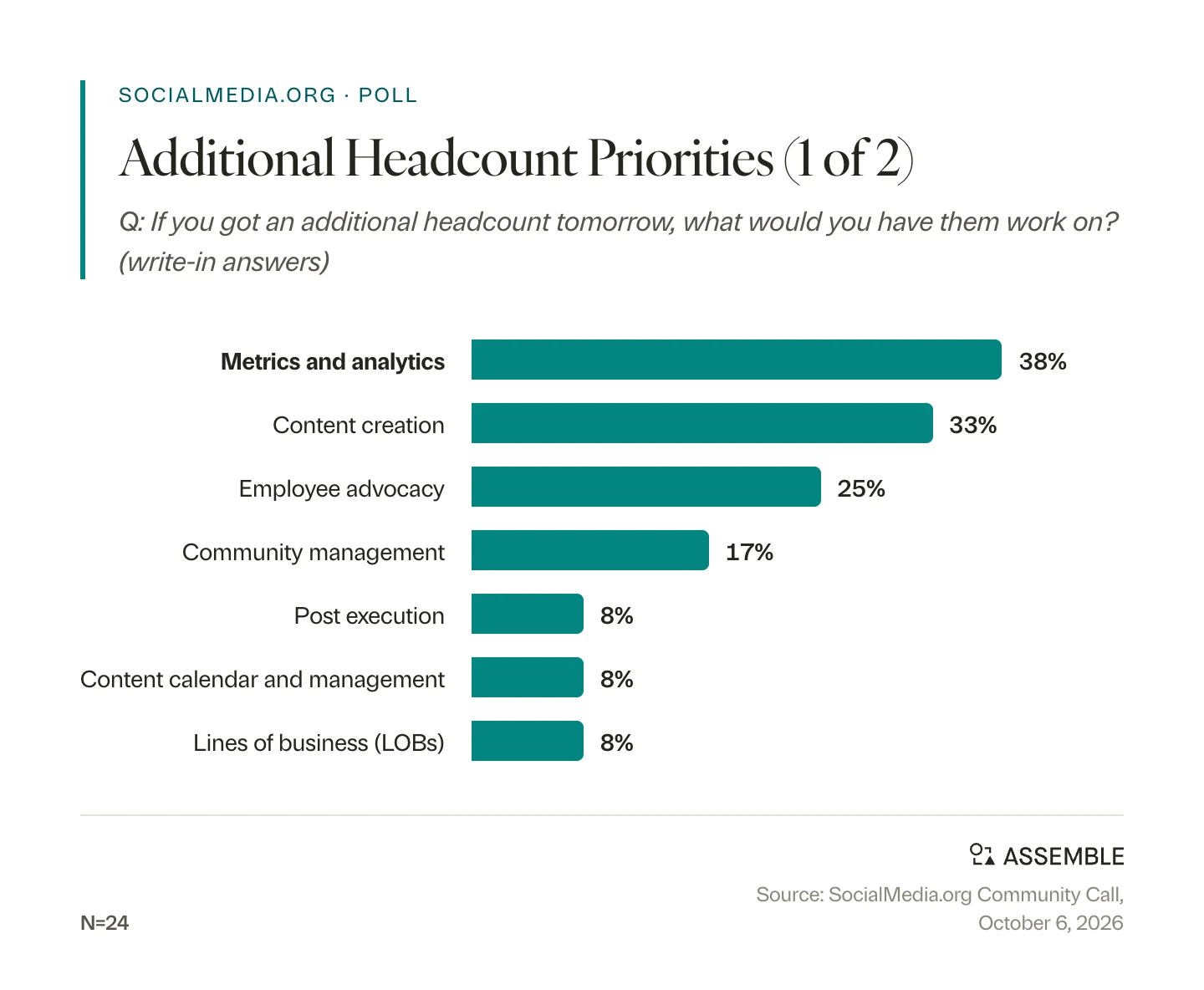
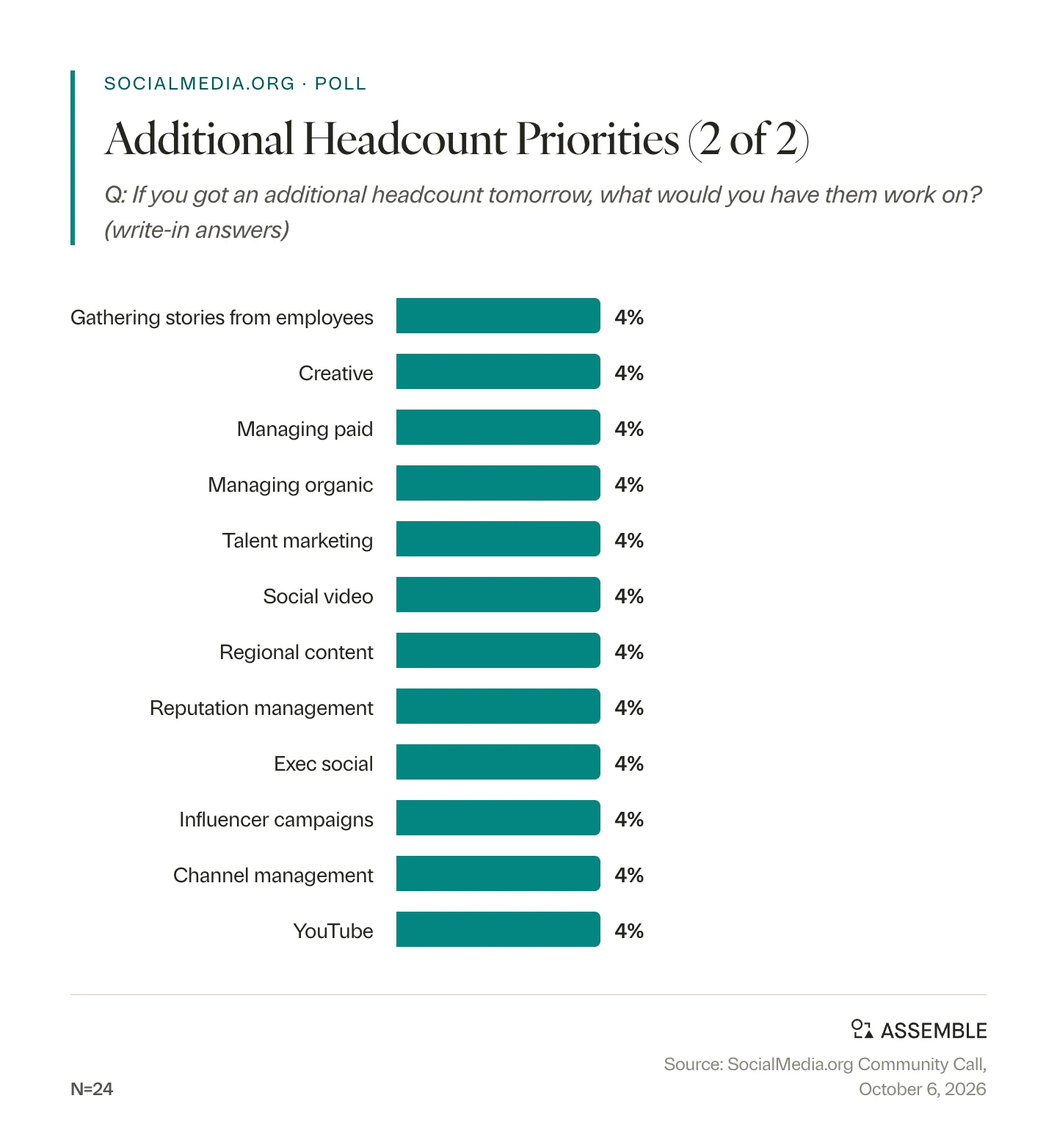
With limited capacity for strategic work, members are finding ways to do more without taking on unsustainable responsibilities. Asked where an additional hire would make the biggest difference, 38% prioritized metrics and analytics, followed by content creation (33%) and employee advocacy (25%). The discussion surfaced practical approaches to extending production capacity, making resource needs visible, and setting boundaries around new work.
“My trick is I never say ‘No’. I always say, 'Yes, here's what you need to do, and here's how much money I need to do that.”
Poll results
Focus of the Discussion
Making the Work Visible Before Taking on More
Members are finding ways to extend production capacity without adding headcount. Some are training communications partners to capture social-first video, tapping employee resource groups for stories, and using interns to develop content guidelines. Others are making workload more visible through time tracking, detailed briefs, and creative timelines to strengthen resource requests and manage expectations.
But successful experiments can create new expectations. Members described testing short-form video with borrowed equipment and internal experts, while weighing whether they could sustain production long term. AI is helping automate reporting and dashboards, but more advanced workflows still require technical expertise, compliance review, and implementation time — resources already stretched thin.
Key Takeaways
Small social teams’ biggest struggle: the gap between expectations and capacity. Members described teams of one or two supporting enterprise brands while owning organic social, paid, community management, reputation, employee advocacy, reporting, and increasingly video. Whew! That they’re pulling it all off can mean the organization doesn’t see the strain. Several members said the challenge is moving beyond “keeping the lights on” long enough to actually evolve the program.
“Social first” is not a bolt-on that comes after everything else. Members repeatedly described receiving creative built for websites, display, internal communications, or other formats and then being asked to “just post it.” Some members aim to build capability outside their immediate function -- training communications partners to capture usable video, tapping interns and internal experts, creating content-capture guides, and sourcing more authentic material from ERGs and employees. Finding ways to scale help with the content volume problem while potentially bringing new perspectives to the messaging.
The most useful version of “no” may actually be “yes ... here’s what it takes.” Members shared a range of ways to push back without simply becoming the team that blocks ideas: requiring briefs and 6–8 weeks lead times, showing creative timelines, or needing audience personas and 90-day content calendars. One member said detailed time tracking ultimately helped make the case for additional headcount.
Experimentation can earn social teams credibility — just be careful for what you wish for. Members wrestled with the tradeoff between refusing work they cannot sustain and saying yes to strategically valuable tests. A successful pilot can demonstrate what social can do and build the case for investment, but members warned that organizations can quickly interpret “we proved we can do this” as “we can now do this forever.” Small teams need to define the ongoing operating cost alongside the results of the experiment, before expectations take hold.
AI may help small teams scale, but members don’t see it as a substitute for capacity. Teams are already finding practical efficiencies in areas such as paid campaign reporting and dashboard creation, and there was strong interest in moving toward more sophisticated AI-enabled workflows and agents. But building scalable, compliant workflows requires time, expertise, governance (and in regulated industries, significant constraints around what AI can touch). The emerging opportunity is less about asking AI to create another post and more about redesigning repetitive workflows — while recognizing this work needs time and brainpower, both of which are often used to keep plates spinning.
About SocialMedia.org and Assemble
SocialMedia.org is an Assemble community that helps senior social media leaders at the world's largest companies make better, faster decisions through trusted peer insights.
We selectively share highlights from confidential member conversations to help leaders understand how peers are navigating complex challenges and fast-moving decisions.
If you'd like to learn more about the conversations happening inside our peer network, or how members connect with trusted peers to solve critical challenges, please contact us.