The Story in Brief

“There’s a tendency to attribute retention challenges to the broader environment, but what we’re hearing from members is that internal change is the dominant driver of uncertainty. Employees are reacting to what they see and experience day to day, including leadership decisions, communication gaps, and shifting expectations. The work now is less about eliminating uncertainty and more about how leaders show up within it.”
Picking Up the Story
Retention Risk Is Emerging in Unexpected Places
Workforce uncertainty is no longer episodic—it’s becoming a steady operating condition.
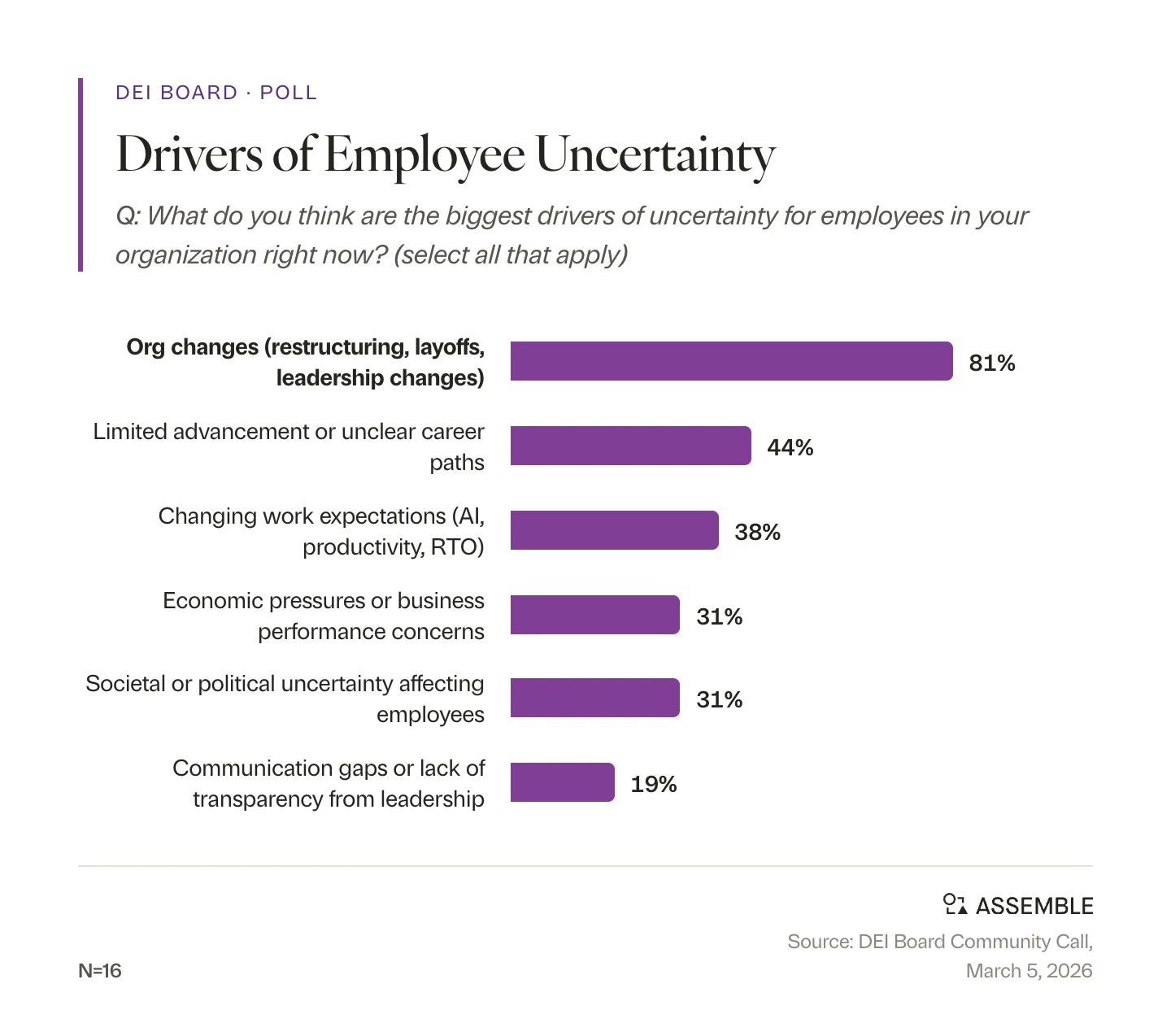
Organizational changes were cited by 81% of members as the primary driver of uncertainty, far outweighing other factors like economic pressure (31%), or political or societal uncertainty (31%).
Members explored how this environment is affecting trust, engagement, and retention.
“During uncertainty, people pay very close attention to how leaders show up, communicate, and follow through on what they say they’re going to do.”
Poll results
Focus of the Discussion
Leaders Can’t Eliminate Uncertainty, but Showing Up Matters
Uncertainty is no longer something to resolve, but something to manage.
Organizational changes are shaping how employees interpret every leadership decision. That scrutiny is making trust more fragile. As one participant noted, “If employees don’t understand why decisions are being made, they tend to fill in the gaps themselves.”
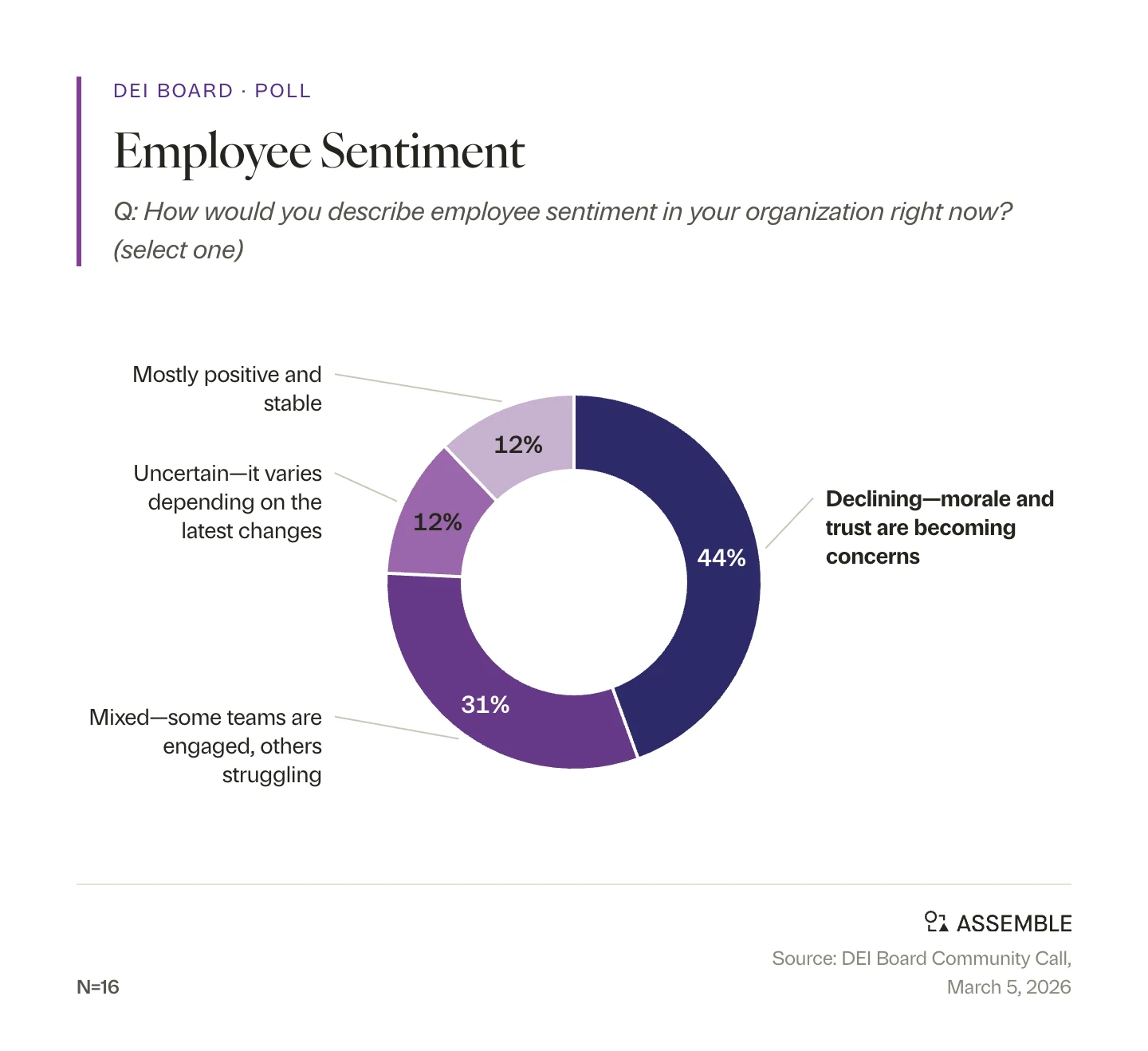
At the same time, traditional engagement tools are falling short. Surveys capture sentiment, but they don’t guarantee action or belief. The impact of layoffs adds another layer, affecting morale for employees who remain. Over time, this environment can shift retention patterns, with high performers leaving early, and others disengaging.
Key Takeaways
Restructuring, layoffs, and leadership changes came up repeatedly as signals employees are watching closely when trying to interpret the stability and direction of their organization. Members described employees closely monitoring leadership decisions and messaging during periods of organizational change.
Trust in leadership can become more fragile during periods of organizational volatility. Leaders described employees questioning whether leadership is being fully transparent about workforce decisions. Even when leaders communicate frequently, employees may remain skeptical about whether they are seeing the complete picture. Some members shared that increasing leadership visibility and demonstrating how feedback informs decisions can help narrow this gap. Still, participants noted that rebuilding confidence during periods of change takes time and consistent follow-through.
Several DEI teams noted that collecting engagement feedback does not automatically translate into employee trust. While engagement surveys remain a common tool for understanding workforce sentiment, members said employees often question whether their feedback leads to meaningful action. In some cases, employees doubt that leaders even see the full survey results. To address this, some organizations now require leaders to publish action plans tied to engagement findings. Even with those steps, members acknowledged that convincing employees that their voices are truly influencing decisions remains an ongoing challenge.
The effects of layoffs can often extend well beyond the employees who leave. Members described how workforce reductions can create emotional strain, heavier workloads, and new uncertainty for the employees who remain. When organizations focus primarily on the exit process, the needs of those staying behind can sometimes receive less attention. Leaders highlighted the importance of acknowledging this dynamic, and supporting remaining employees through the transition. Without that support, teams said morale can decline even further in the aftermath of layoffs.
Rather than attempting to solve large organizational shifts themselves, many teams said they are concentrating on supporting their teams through change. This includes maintaining transparency within their scope, addressing concerns directly with employees, and reinforcing trust, one team at a time. Members described this as a practical way to maintain stability in their immediate environment, even when broader organizational conditions remain unsettled.
About the DEI Board and Assemble
The DEI Board is an Assemble community that helps senior diversity, equity, inclusion, belonging, and culture leaders at the world's largest companies make better, faster decisions through trusted peer insights.
We selectively share highlights from confidential member conversations to help leaders understand how peers are navigating complex challenges and organizational change.
If you'd like to learn more about the conversations happening inside our peer network, or how members connect with trusted peers to solve critical challenges, please contact us.