The Story in Brief

“Inclusion learning is becoming less visible as a standalone program, and more embedded across the organization. That shift is driven by both strategy and necessity, as teams respond to legal guidance, scalability challenges, and internal expectations. What’s unresolved is how to balance effectiveness, consistency, and engagement as these programs evolve.”
Picking Up the Story
Shaping the Future of DEI Training
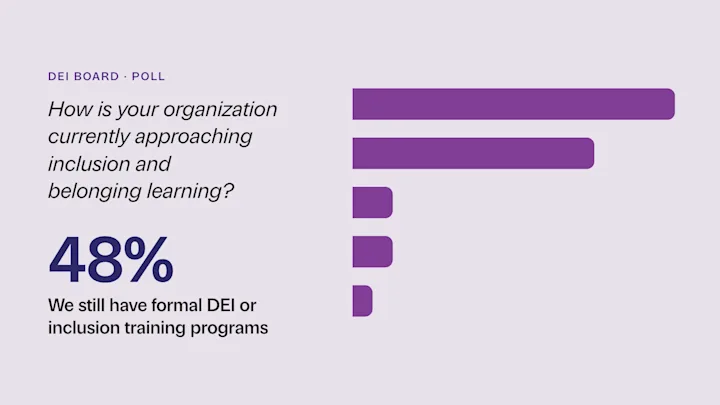
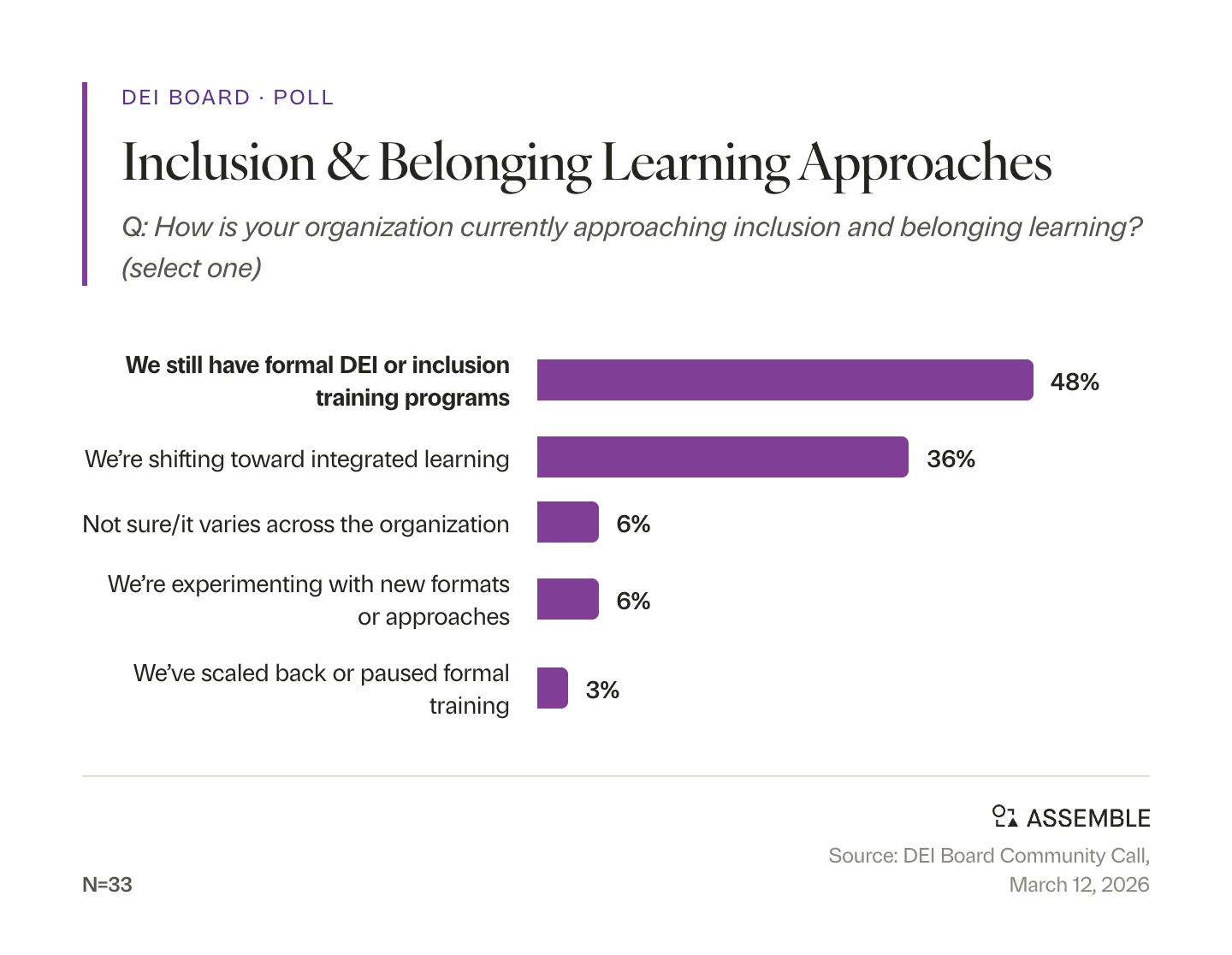
Inclusion and belonging training remains a priority for most organizations, but how it’s delivered is shifting. Only 3% of members reported scaling back their efforts, but many are adjusting the content, scope, or positioning.
48% of members said they still have formal training programs, while 36% are moving toward integrated learning models embedded into leadership and business processes. Members explored how organizations are adapting these programs in a changing environment.
“Belonging isn’t something we can force on anyone; there are structural dynamics that impact groups and individuals differently.”
“We’ve always approached training with an ‘inspire vs. require’ viewpoint.”
Poll results
Focus of the Discussion
Teams Are Focused on Adaptation, Not Elimination
Embedding DEI into Onboarding, Development, and Leadership Efforts
Organizations are not stepping away from DEI training—they’re changing how it fits into the business.
Rather than standalone training, organizations are integrating inclusion into leadership development, onboarding, and performance conversations. This reflects an effort to move inclusion out of a separate track, and into everyday leadership behavior. As one participant explained, “We define inclusion as the action or behavior, and belonging as the outcome.”
At the same time, there is no consensus on participation models. Required training ensures consistency and scale, but can feel performative. Optional training is often perceived as more genuine, but participation tends to be limited.
At a foundational level, even the language of inclusion is under debate. The concept of belonging, in particular, raised questions about whether it can be meaningfully taught or measured, adding another layer of complexity to program design.
Key Takeaways
Most organizations are maintaining some form of DEI training, but many are making adjustments. Members described keeping training in place while narrowing scope, updating language, or tying it more directly to business outcomes and risk. In some cases, content has been simplified or “scrubbed” in response to external pressures. In some regulated environments, particularly financial services, organizations are maintaining more explicit and required training tied to compliance and risk mitigation.
No clear agreement on whether training should be required or optional, with tradeoffs between consistency and engagement. Some organizations continue to require training, especially for leaders, to ensure consistency and shared expectations, while others are leaning toward optional models to encourage more genuine engagement. A few are taking a hybrid approach, requiring training for certain groups, and opening it more broadly on a voluntary basis.
In-person and experiential learning is often seen as impactful, but scaling it remains a real constraint. Several members pointed to facilitated, in-person sessions and experiential formats as the most effective for shifting behavior and perspective. Speaker series and interactive discussions were also highlighted as strong formats. At the same time, these experiences can be difficult to deliver to large or, so many teams rely on virtual or microlearning options, though they’re often seen as less impactful.
The idea of “belonging”still feels fluffy, with different views on what it means or how to measure it. Some members are leaning into “belonging” as a more accessible or outcome-focused framing, while others are questioning whether it’s the right term, or whether it can be clearly defined and measured. A few raised concerns about how belonging interacts with power dynamics, and whether it’s something organizations can meaningfully create.
About the DEI Board and Assemble
The DEI Board is an Assemble community that helps senior diversity, equity, inclusion, belonging, and culture leaders at the world's largest companies make better, faster decisions through trusted peer insights.
We selectively share highlights from confidential member conversations to help leaders understand how peers are navigating complex challenges and organizational change.
If you'd like to learn more about the conversations happening inside our peer network, or how members connect with trusted peers to solve critical challenges, please contact us.