The Story in Brief

“Members are no longer asking whether they should use AI. They're asking: Where does it help us? Where do humans need to stay involved? And really, how do we use it without losing the nuance that matters in the CSR space?”
Picking Up the Story
Building AI Fluency Inside an Already-Full Job
AI expectations are rising across the enterprise, adding a new capability requirement for CSR leaders already managing stretched teams and broad portfolios. Heading into 2027, the challenge is finding enough time and practical exposure to build real fluency.
Leaders came together around that learning curve: how to get better at AI, where the remaining skill gaps are, and how to make experimentation manageable alongside the work already on the calendar.
“I don't think we need to use AI for everything. I think we can use it when it makes our work smarter and better, or to play with it, because it is fun to play with. However, I'm also trying to not use it in a lot of places because I think that keeps us sharper as well.”
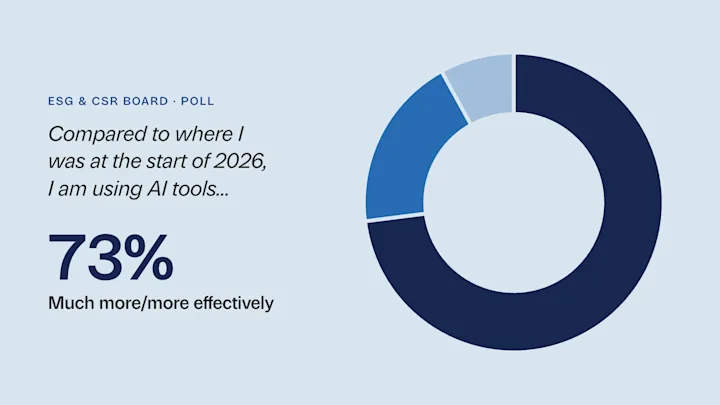
Poll results
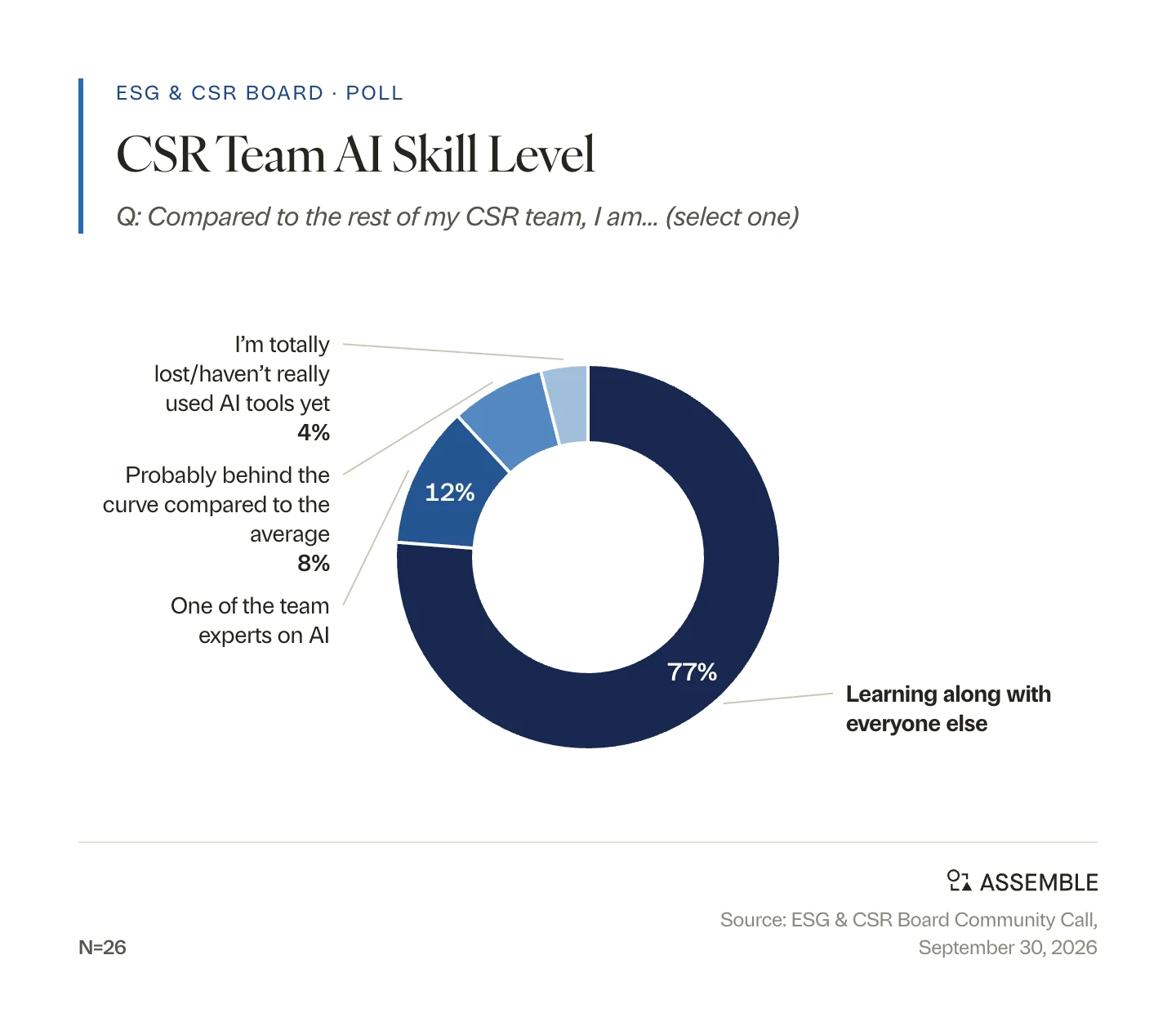
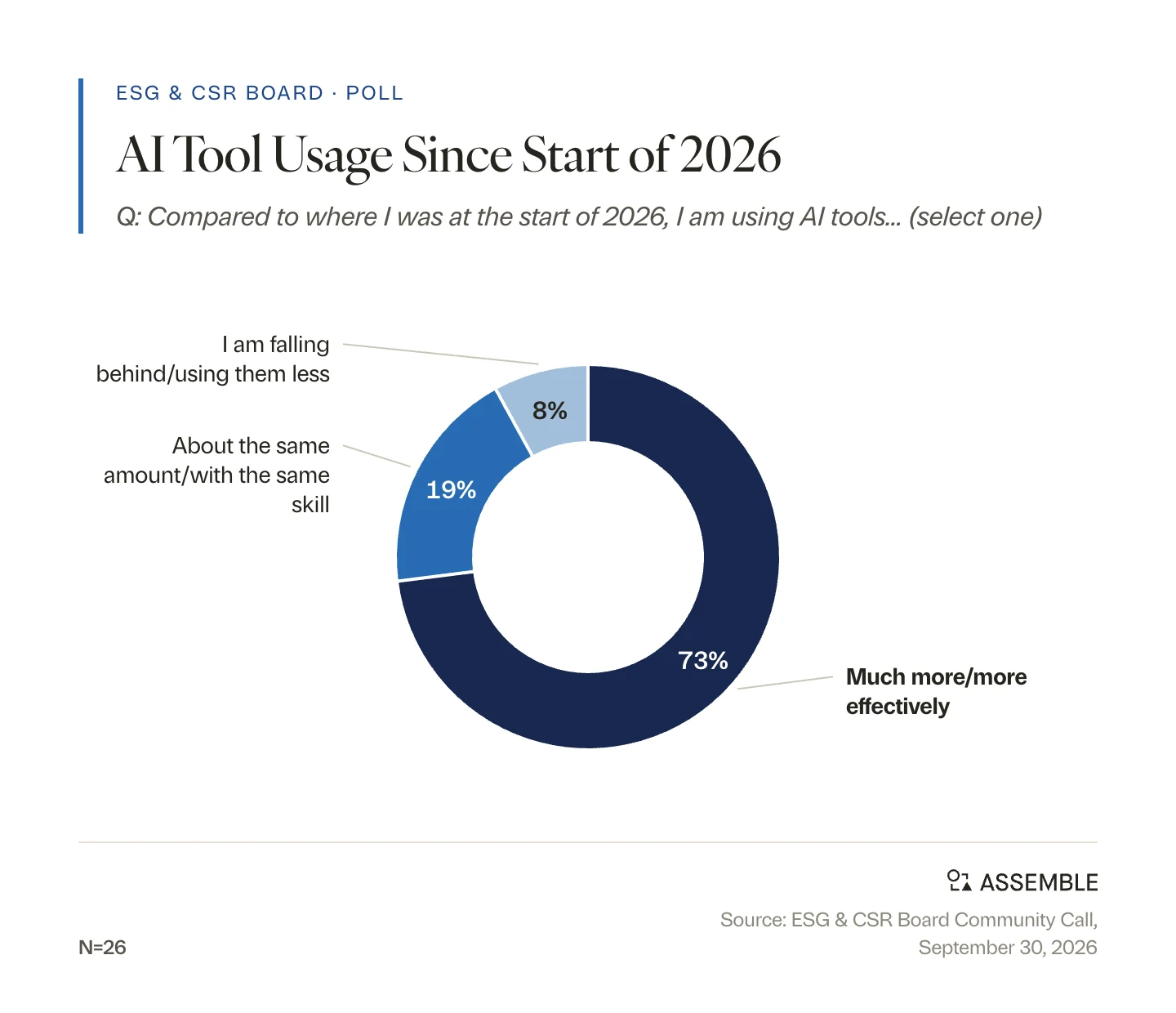
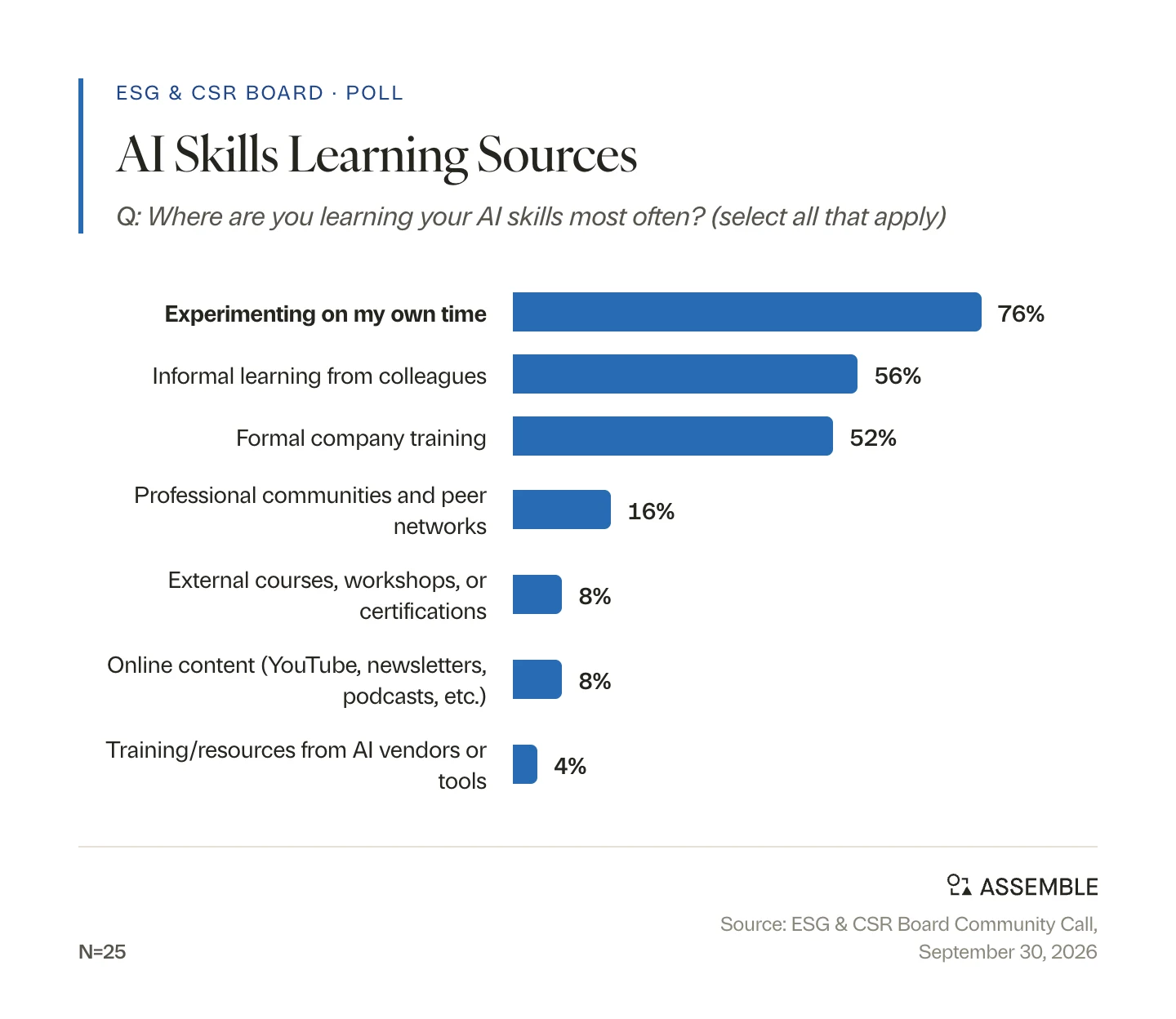
Focus of the Discussion
AI Fluency Is Becoming a Question of Judgment
The clearest progress is showing up in work with defined inputs, repeatable steps and checkable outputs. One team cut a roughly 19-step charitable-contribution risk review from about 45 minutes to 10; others are testing AI for nonprofit monitoring, raters and rankers, volunteer support and limiting agents to specific source libraries. More sophisticated uses bring an operating burden with them: source restrictions, data quality, hallucinations and ongoing review all affect whether a workflow remains trustworthy.
The harder decisions sit at the edges of those workflows. Nonprofit relationships, funding decisions and other context-heavy work depend heavily on human judgment, even as AI reaches into more strategic analysis. Teams are also testing whether impact, partner and community data can surface useful patterns about where programs should focus, raising the stakes for how leaders validate AI-generated analysis and determine its role in consequential decisions.
Key Takeaways
Assess maintenance before you automate. Before building an agent, assess what it will take to keep its sources, prompts and underlying data reliable. External research or messy inputs can require enough checking and oversight to reduce the time savings of an otherwise useful workflow.
Define the decision AI can influence. Separate information gathering, analysis, recommendations and final decisions when designing the workflow. In the charitable-contribution example, AI accelerated screening while the governing committee retained the funding decision. Apply that same test wherever context, trust or organizational accountability carry weight.
Put experiments on the team agenda. Use existing meetings or forums for people to show the task, prompt, result and failure points behind an AI experiment. Members described sharing wins, learnings, and real examples in existing team meetings, which helped colleagues become more willing to experiment themselves.
Set a higher bar for building an agent. Test whether prompting, document comparison or analysis can solve the problem before investing in a custom workflow. Agents require more setup, source control, and testing, so members suggested being selective about when an agent is actually necessary.
Benchmark strategic analysis against expert judgment. For qualitative and strategic analysis, give AI the categories an experienced practitioner would use, then compare its output with human analysis before expanding its role. In one test, human qualitative analysis was stronger while the AI analysis remained directionally useful; the lesson was to improve the framing and probe with questions such as “what’s surprising?” and “what am I not seeing?”
About the ESG & CSR Board and Assemble
The ESG & CSR Board is an Assemble community that helps senior ESG, sustainability, and CSR leaders at the world's largest organizations make better, faster decisions through trusted peer intelligence.
We selectively share highlights from confidential member conversations to help leaders understand how peers are navigating complex workforce challenges and emerging opportunities.
If you'd like to learn more about the conversations happening inside our peer network, or how members connect with trusted peers to solve critical challenges, please contact us.