The Story in Brief

“This conversation showed that teams are not making wholesale changes to social strategy, but they are starting to test and adapt at the edges — especially around structure and platform choice. The real shift is not tactical yet; it's about developing a point of view on how far to lean into discoverability without compromising what makes social effective.”
Picking Up the Story
Optimization Shouldn’t Compromise Authenticity
Social content has always been optimized — for algorithms, engagement, and platform norms. But as AI systems increasingly determine whether content gets surfaced at all, a new layer of pressure is hitting social teams: maintaining authenticity while working to please the machine.
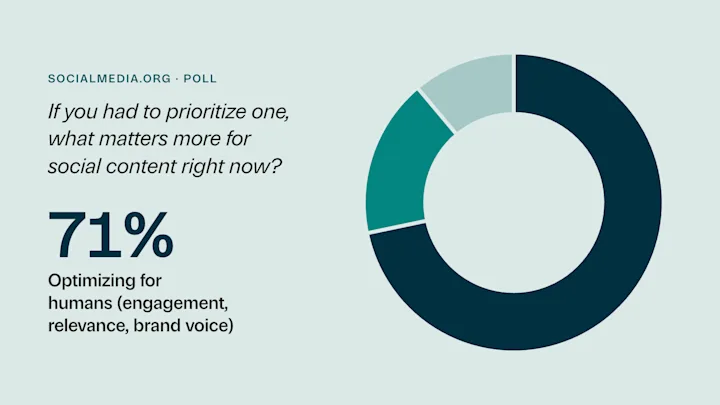
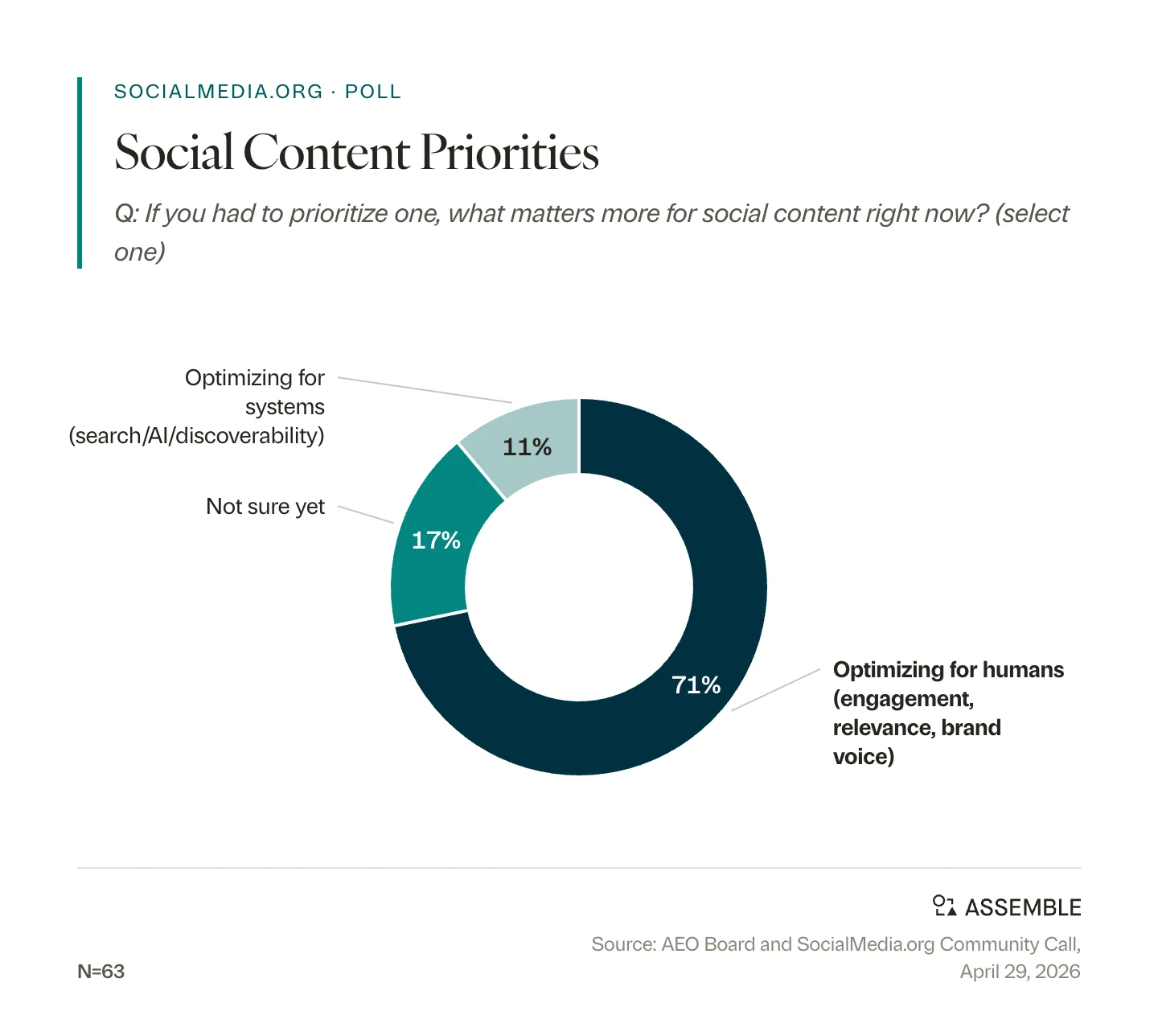
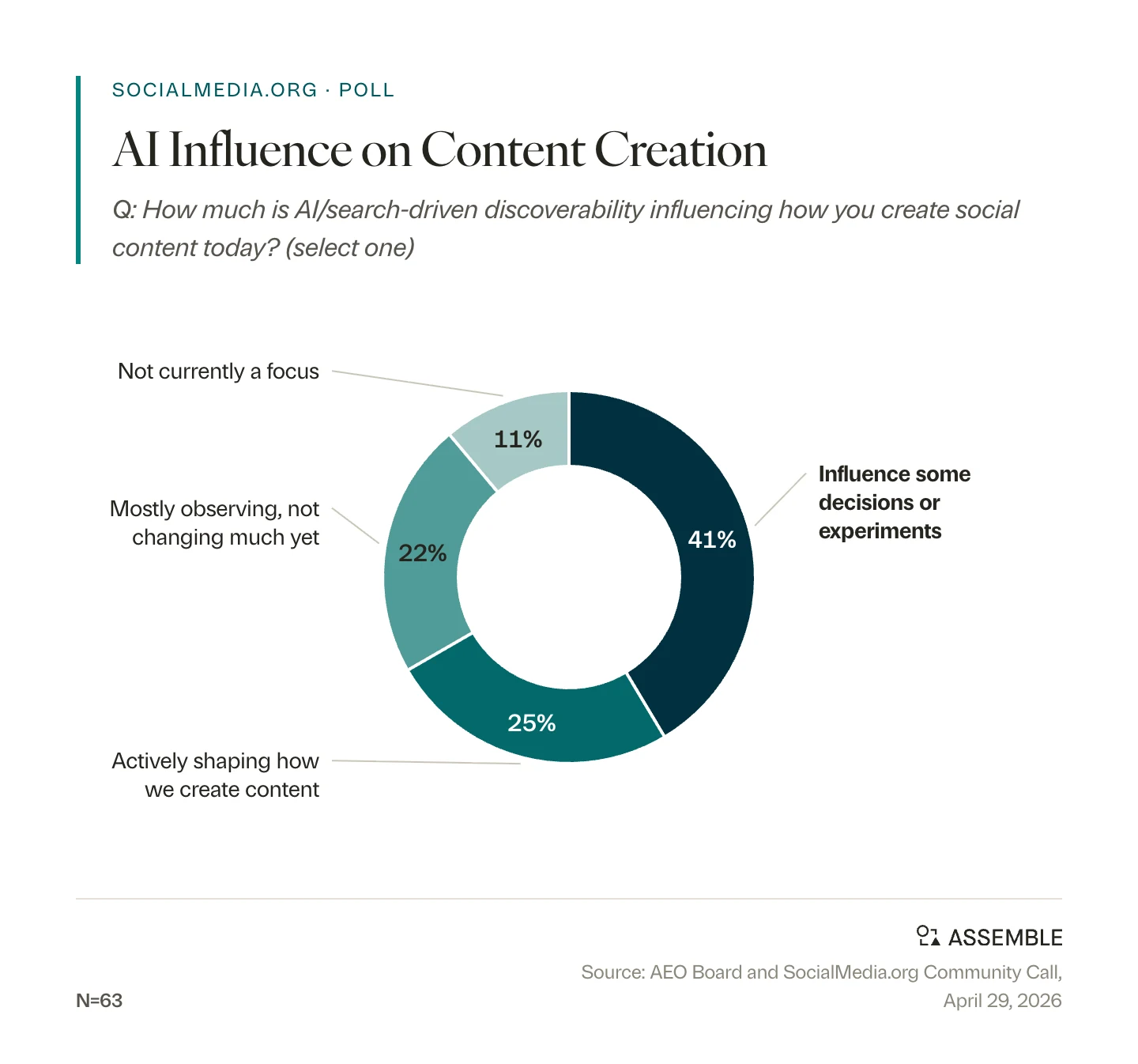
71% of members said optimizing for people is still what matters most. But 66% said AI-driven discoverability is already influencing at least some of their content decisions.
1. If you had to prioritize one, what matters more for social content right now?
Optimizing for humans (engagement, relevance, brand voice): 71%
Not sure yet: 17%
Optimizing for systems (search/AI/discoverability): 11%
Total N: 63
2. How much is AI/search-driven discoverability influencing how you create social content today?
Influence some decisions or experiments: 41%
Actively shaping how we create content: 25%
Mostly observing, not changing much yet: 22%
Not currently a focus: 11%
Total N: 63
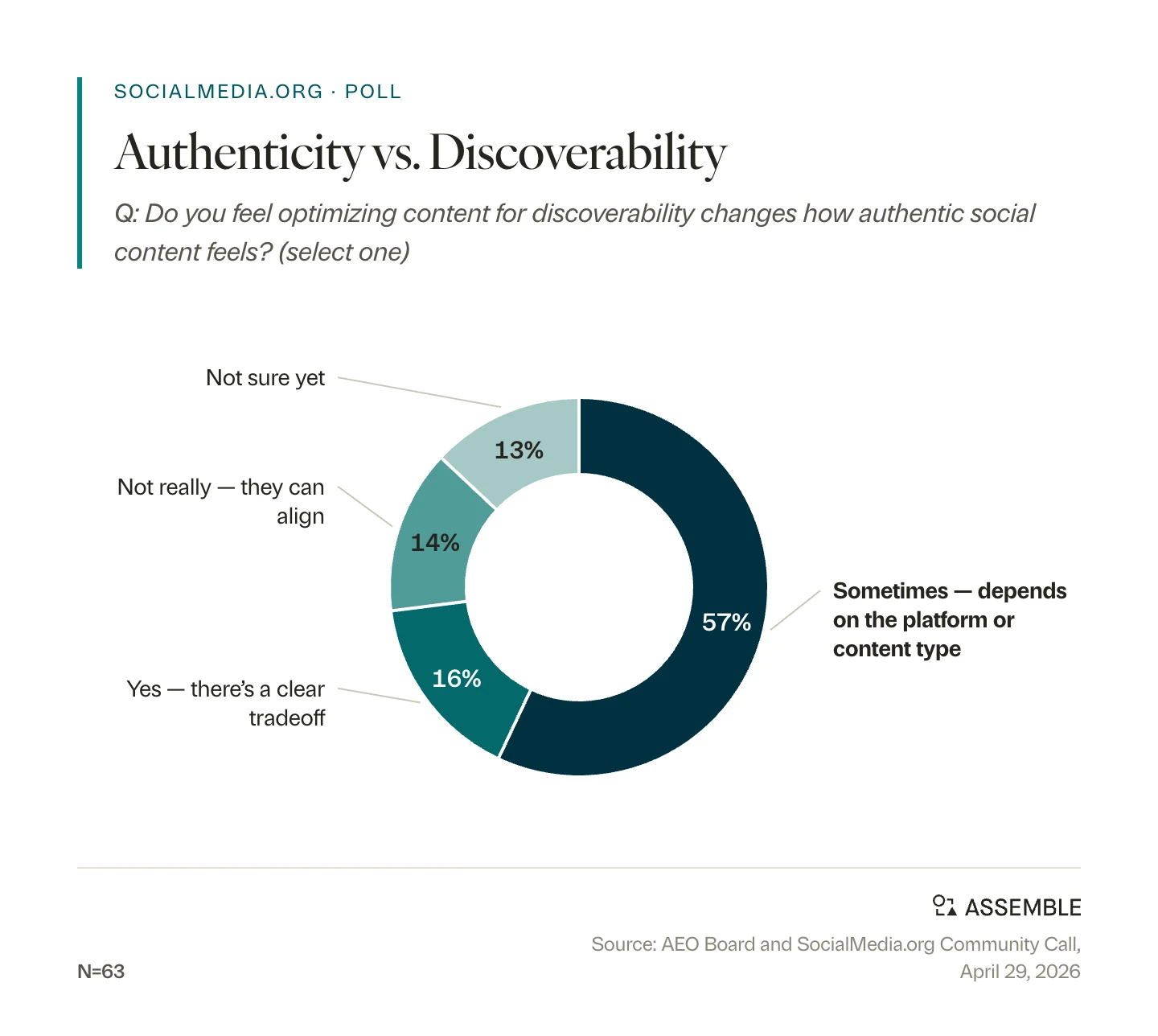
3. Do you feel optimizing content for discoverability changes how authentic social content feels?
Sometimes — depends on the platform or content type: 57%
Yes — there’s a clear tradeoff: 16%
Not really — they can align: 14%
Not sure yet: 13%
Total N: 63
“What works for a human could very well make you invisible to an AI agent.”
Poll results
Focus of the Discussion
Experimentation in Captions, Platforms, and Search Inputs
Some teams are optimizing for discovery while others are finding ways to better connect with their audience. Members report investing in richer captions, titles, and metadata — especially on YouTube and LinkedIn.
For example, one member described optimizing Shorts, titles, chapters, and descriptions together, with early evidence that better-structured YouTube content increases appearances in AI Overviews. Another is using website search queries to shape influencer briefs and steer storytelling toward questions audiences are really asking.
Members also considered the role of social as AI reshapes discovery. Awareness, lower funnel, community, and discovery-adjacent are all still in scope, though most organizations say they have not started working through a model for the future.
Key Takeaways
Teams are adapting on the edges rather than overhauling strategy. The dominant pattern was incremental, low-risk experimentation rather than structural change. Most members described this as deliberate: protect tone, narrative, and engagement while testing what can be adjusted without breaking the experience.
Clear platform preferences. Unclear path forward. YouTube, LinkedIn, and Reddit are the channels members are prioritizing based on where AI systems are actually pulling from. Members noted that YouTube has particular leverage in Google AI Overviews and that LinkedIn content surfaces frequently in ChatGPT results. But what works in one ecosystem doesn't translate cleanly to another.
Search insights are moving upstream. Several members described using high-intent queries to guide content topics to ground storytelling in questions audiences are actually asking. Early signals suggest this bridges search and social thinking without flattening the content.
Evidence of social content driving AI citation is real but inconsistent — and rarely tied to standalone posts. Members shared instances of LinkedIn content and social responses appearing in AI outputs, but citations more often traced to third-party sources or content clusters than to brand pages directly. Social's contribution to discoverability appears more likely when posts are part of a broader asset ecosystem. The attribution gap makes major strategy shifts difficult to justify.
The more consequential question may be what social is for, not how to optimize it. As AI changes the discovery layer, social's role across the funnel is less fixed than it was. Members raised real uncertainty about whether social belongs in awareness, lower funnel, community, or discovery — and whether AI will blur those roles further. Developing a provisional point of view on this now, rather than waiting for clarity, was the takeaway several members left with.
About SocialMedia.org and Assemble
SocialMedia.org is an Assemble community that helps senior social media leaders at the world's largest companies make better, faster decisions through trusted peer insights.
We selectively share highlights from confidential member conversations to help leaders understand how peers are navigating complex challenges and fast-moving decisions.
If you'd like to learn more about the conversations happening inside our peer network, or how members connect with trusted peers to solve critical challenges, please contact us.