The Story in Brief

“Manufacturing leaders don't lack change management, they're applying it inconsistently. Process changes typically receive structured review, but rapid cost-cutting decisions often don't receive the same level of scrutiny, even though they can reshape operational capability just as significantly. The opportunity isn't slowing decisions down. It's applying the same governance, ownership, and follow-up to cost-saving changes that organizations already expect for operational ones.”
Picking Up the Story
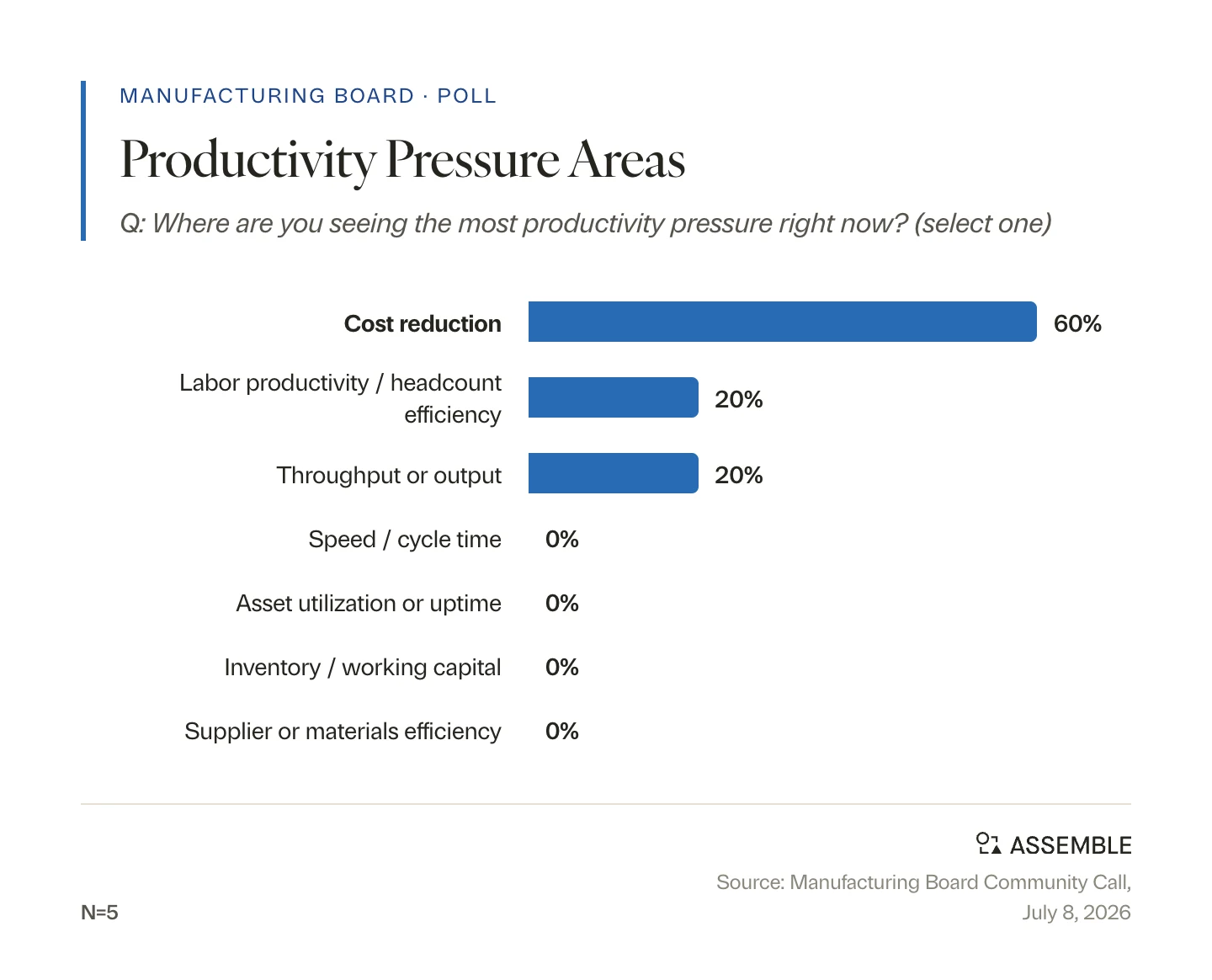
The Next Productivity Challenge
For many manufacturers, productivity is no longer just about identifying the next major improvement project. Tariffs, inflation, and rising costs are forcing leaders to make a growing number of smaller cost-saving decisions, often faster than traditional improvement cycles are designed to support.
That raised a practical question for the group: How do manufacturers keep moving quickly without introducing operational risks that only become visible after the savings have been realized?
“I don't think we always do that when it comes to cost reduction... What's the impact? What's my control plan? How will I know?”
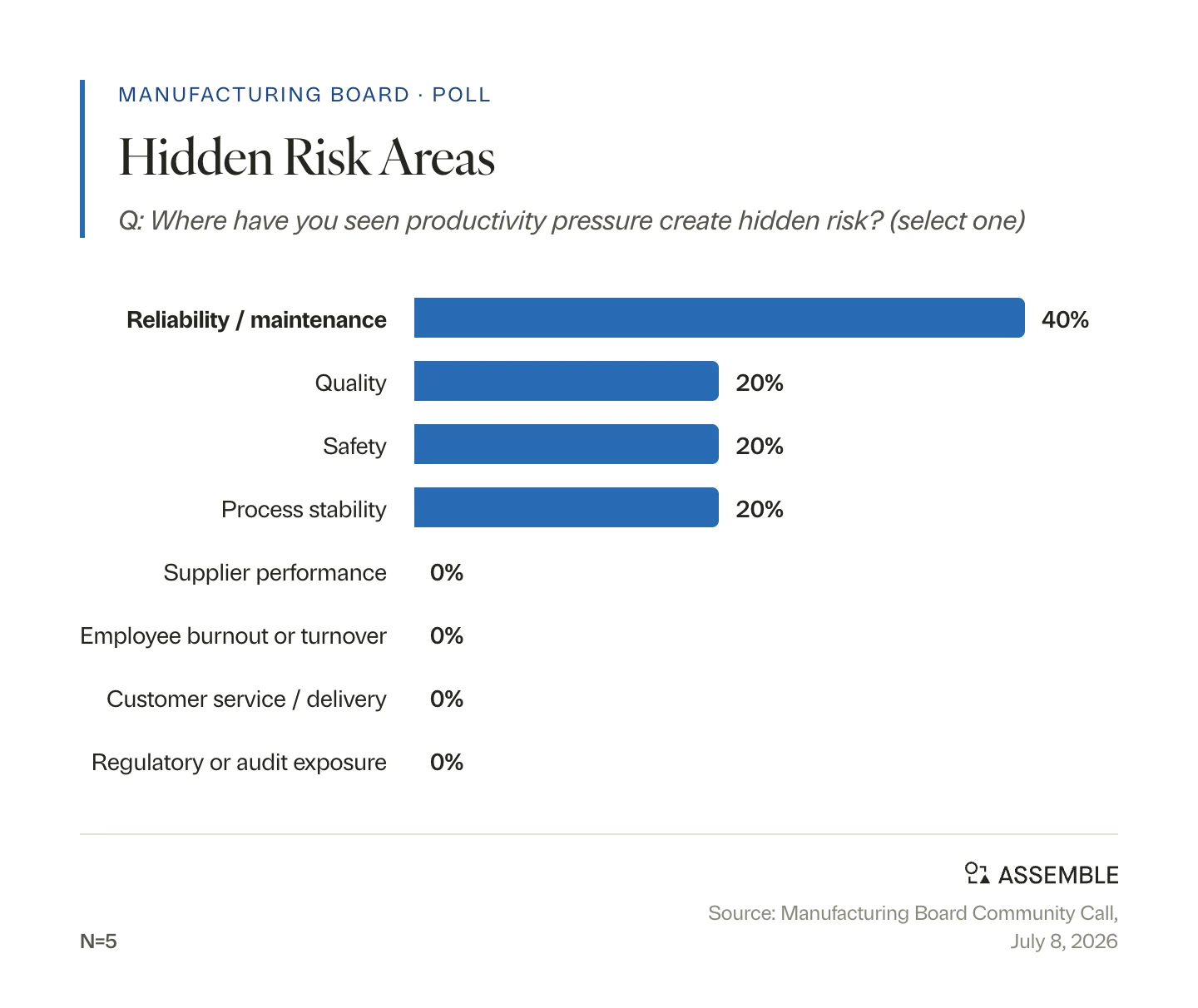
Poll results
Focus of the Discussion
Cost-Cutting Often Moves Through a Different Governance Lane
Manufacturing organizations have well-established processes for evaluating engineering changes, capital projects, and other operational modifications. But many leaders acknowledge that the same rigor is not always applied when the objective is to reduce costs. Staffing reductions and organizational changes can fundamentally reshape an operation, yet they may move faster — and with less structured review — than process changes.
The gap often appears after implementation. The savings may be immediate, but the operational tradeoffs can take months to surface. Members pointed to a growing need to monitor productivity initiatives over time, not just approve them before they go live. Longer-term verification is becoming a more deliberate part of change management, helping leaders determine whether improvements are actually sustainable or whether cost and risk have shifted elsewhere in the operation.
Key Takeaways
Apply the same change-management discipline to cost reductions that you already apply to process changes. Many organizations already have mature governance for engineering and operational changes, while cost-saving decisions often move through a different process. Extending the same level of risk assessment to staffing, organizational, and capability changes helps surface downstream impacts before they become costly to reverse.
Pressure-test whether the change actually removes work from the system. A cost reduction is not always a productivity improvement. Before approving a change, leaders should ask whether the work has been eliminated, simplified, automated, or redesigned — or whether the same work is simply being pushed onto fewer people, less capacity, or another part of the operation.
Define the monitoring plan before the change goes live. Teams need to know what will be measured, who owns the review, how often the data will be checked, and what will trigger escalation. Building that plan before implementation creates shared accountability for what happens after the savings are realized.
Use leading indicators to detect whether risk is shifting elsewhere. Savings may show up quickly, while operational consequences can take longer to surface. Expanding measurement beyond the savings target — including process variation, scrap, maintenance demand, absenteeism, turnover, safety observations, supplier performance, and control-limit movement — gives leaders a clearer view of whether the improvement is strengthening the operation or simply moving risk somewhere else.
Schedule follow-up reviews after the savings have landed. Many unintended consequences only become visible after the operation has absorbed the change. Follow-up reviews at set intervals help leaders confirm whether the improvement is sustainable, whether new costs have emerged, and whether corrective action is needed before issues become systemic.
About the Manufacturing Board and Assemble
The Manufacturing Board is an Assemble community that helps senior manufacturing leaders at the world's largest organizations make better, faster decisions through trusted peer conversations.
We selectively share highlights from confidential member discussions to help leaders understand how peers are approaching complex operational challenges and emerging industry trends.
If you'd like to learn more about the conversations happening inside our peer network, or how members connect with trusted peers to solve critical challenges, please contact us.