The Story in Brief

“Members are gravitating toward global privacy notices with jurisdiction-specific addenda, but the bigger operational challenge may be how those notices are hosted and maintained. Even small changes can become complicated when they require multiple translations, publishing steps, and coordination across platforms. The question now is how to make these notices easier to maintain while keeping them accessible and understandable.”
Picking Up the Story
Keeping Privacy Notices Current Across Jurisdictions
Evolving privacy regulations, new AI applications, and acquisitions are complicating how multinational organizations communicate their data practices. Requirements differ across jurisdictions and populations, creating questions about what must be disclosed, where, and when.
With each change potentially affecting multiple notices, languages, and websites, maintaining accurate and understandable disclosures is becoming an increasingly demanding responsibility.
“We're really trying to get to the point where we have something that's much more data-driven and dynamic.”
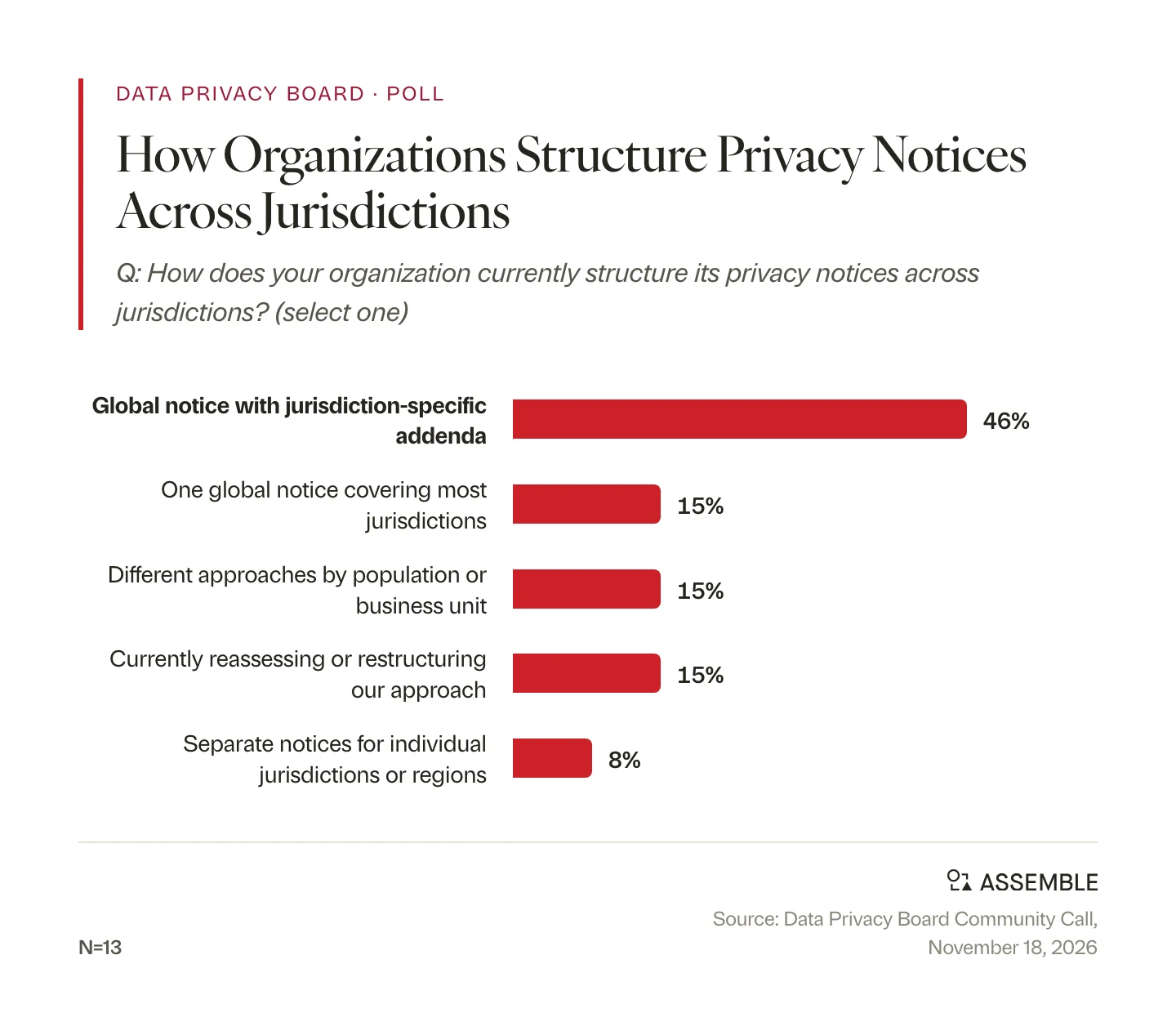
Poll results
Focus of the Discussion
Flexible Notice Structures Are Exposing New Operational Tradeoffs
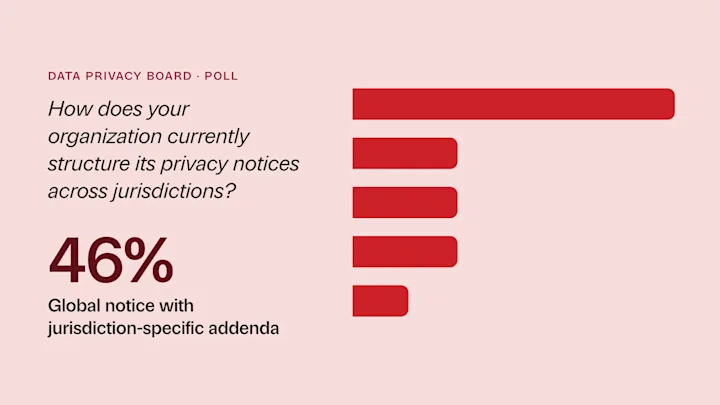
Global notices with jurisdiction-specific addenda are gaining traction, while some organizations are exploring dynamic formats that display information based on an individual's location. Population-specific notices add another layer of flexibility, particularly for employees, applicants, and consumers.
Publishing limitations proved especially consequential. One organization described how minor changes can trigger weeks of translation and coordination, while others reported greater control through OneTrust's Privacy Notice Manager or Adobe Experience Manager. The choice of platform is increasingly shaping how quickly privacy functions can respond to changing requirements.
AI disclosures and acquisitions are also testing existing notice structures. Additional disclosures are appearing within specific customer and applicant workflows, while employee notices are being tied to acquisition integration timelines. Readability remains a point of divergence, with some organizations pursuing simpler language and others strengthening legal specificity as AI tools make perceived gaps easier to identify.
Key Takeaways
Separate global notice content from jurisdiction-specific requirements. A global baseline with local addenda can reduce the need to revise an entire notice for every regulatory change. Assess whether different populations need their own notices and whether dynamic presentation could make relevant information easier to find.
Prioritize direct publishing control when selecting notice management technology. Platforms that allow privacy functions to make routine updates without relying on web development resources can reduce delays. Evaluate OneTrust's Privacy Notice Manager, enterprise content systems, or existing internal tools against localization needs, reliability, and the resources required to maintain them.
Layer AI disclosures according to where personal data is processed. Broad descriptions of AI use can sit within existing privacy notices, supported by more specific information when individuals encounter an AI-enabled tool. This approach is already being applied to customer service and candidate workflows, allowing disclosures to remain relevant to the activity.
Build employee privacy notices into acquisition integration planning. Use the point at which employee information enters parent-company systems as a checkpoint for issuing or updating notices. Questionnaires and early reviews of acquired companies' data practices can help identify additional obligations before integration begins.
Connect notice updates to existing privacy governance processes. Annual reviews provide a useful baseline, but new laws, AI use cases, and changes identified through privacy impact assessments may require earlier action. Track potential revisions as they arise and establish clear triggers for reviewing them.
Pressure-test readability without sacrificing required legal detail. Tables, clearer explanations, and audience-specific content can improve accessibility, while jurisdiction-specific language preserves necessary precision. Review notices for both comprehension and completeness, particularly as AI-assisted scrutiny makes perceived omissions easier to surface.
About the Data Privacy Board and Assemble
The Data Privacy Board is an Assemble community that helps senior privacy, compliance, governance, and data protection leaders at the world's largest organizations make better, faster decisions through trusted peer insights.
We selectively share highlights from confidential member conversations to help leaders understand how peers are navigating complex challenges and fast-moving, high-stakes moments.
If you'd like to learn more about the conversations happening inside our peer network, or how members connect with trusted peers to solve critical challenges, please contact us.