The Story in Brief

“What stood out is how evenly distributed the market is. You rarely see a perfect split like this, and it signals real uncertainty. Organizations are experimenting, but not committing at scale, largely because measurement frameworks and clear winners haven’t emerged yet.”
Picking Up the Story
Teams Are Watching Closely Before Committing
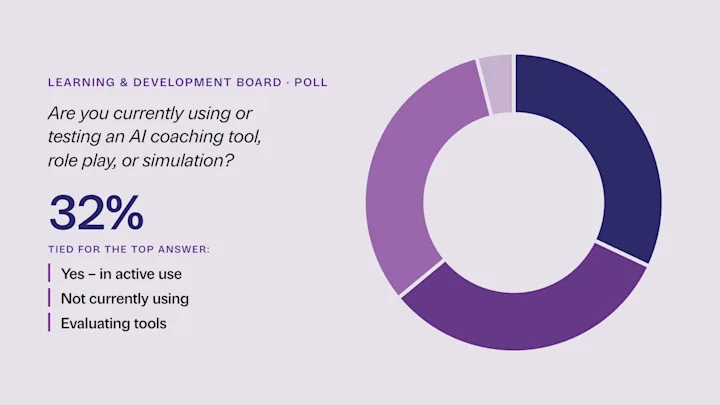
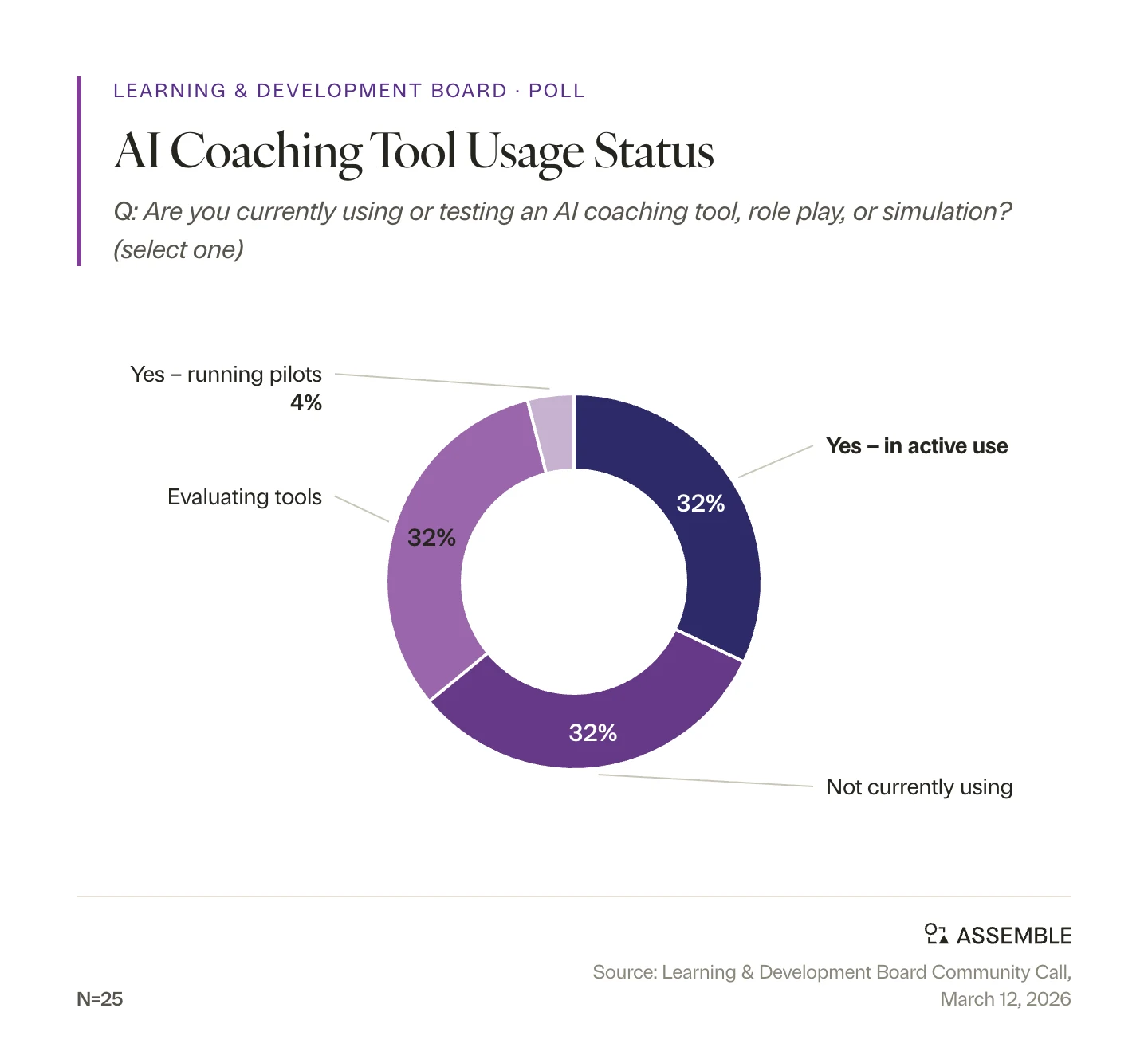
AI coaching is gaining attention across learning and development teams, but adoption is far from settled. Poll data shows an exact three-way split: 32% of organizations are actively using AI coaching tools, 32% are evaluating options, and 32% are not currently using them at all.
This distribution is unusual... and telling. The market is active, but unresolved.
“We’ve been using AI to help leaders practice performance conversations because those discussions are not always the easiest for managers.”
“Getting legal, IT, and the vendor in the room together helped us move forward, because everyone could hear the same answers at the same time.”
Poll results
Focus of the Discussion
Examining Where Adoption is Gaining Traction
AI coaching is easy to deploy across many managerial use cases, but difficult to justify. Organizations see clear potential in AI coaching, but lack the measurement, vendor clarity, and governance pathways to scale it confidently.
Organizations are experimenting widely, embedding tools into leadership programs, sales training, onboarding, and coaching practice. These tools allow employees to build confidence in a way that traditional training cannot. As one participant noted, “The more people used the tool over time, the more comfortable they became practicing and refining their message.”
That flexibility is driving rapid experimentation, but despite that momentum, measuring ROI remains a limiting factor in growing these efforts. Without strong evidence, leaders struggle to justify continued investment.
Key Takeaways
Many organizations are beginning to move AI coaching from concept into early experimentation. In many cases, these tools create structured practice environments where employees can rehearse conversations, refine messaging, and receive feedback within simulated scenarios. Several members highlighted the value of allowing learners to repeat scenarios and improve over time, particularly for difficult conversations like performance management discussions. Organizations are experimenting with placing these tools at different points in development journeys, including pre-work before programs, practice between sessions, and reinforcement afterward.
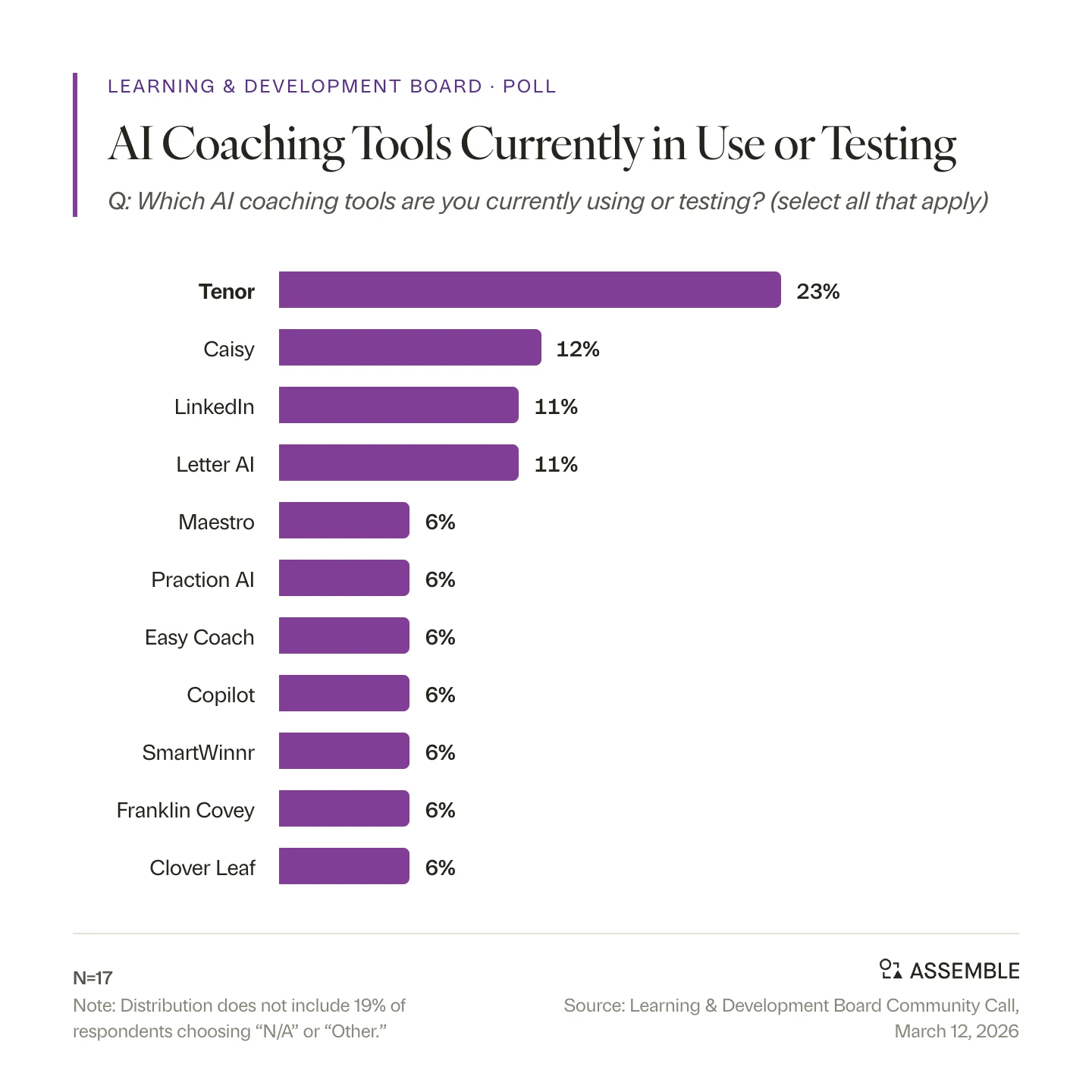
Members described a mix of vendor platforms and internally built solutions, reflecting an evolving build vs. buy landscape. Some teams referenced a wide range of external platforms, while others are also experimenting with internally developed simulations or AI assistants. Internal builds were often described as offering greater customization and the ability to design experiences around highly specific business scenarios. Vendor tools, by contrast, were described as enabling faster deployment.
Some early experimentation is extending beyond traditional L&D use cases. While leadership role plays and coaching simulations remain common entry points, members also shared examples that stretched beyond typical training scenarios. These included AI-supported project simulations in technical environments, tools that analyze leadership communication in meetings, and one example of using AI transcription tools to capture insights from leadership conferences, and convert them into learning artifacts. A few organizations are also exploring real-time coaching assistants embedded within workplace tools, like meeting platforms or messaging systems.
Many teams are still working through how to measure the impact of AI coaching tools. Members noted that existing dashboards often focus on engagement metrics, while organizations rely on signals like learner confidence, manager observation of behavior change, and participant feedback to gauge effectiveness. Some vendor platforms provide dashboards, but several leaders noted that these often offer limited insight into whether skills are actually improving. In some cases, organizations receive raw data from vendors, and have to build their own reporting frameworks to interpret the results.
Vendor evaluation and internal approval processes are emerging as significant barriers for some organizations. Members noted that the number of AI coaching vendors continues to grow quickly, making it difficult to determine which platforms are worth deeper evaluation. At the same time, internal processes, including legal review, cybersecurity assessments, and data privacy evaluations, can slow adoption. Leaders in more regulated industries described approval processes that can take months before a tool is cleared for use. Several participants suggested that involving legal and compliance teams earlier in vendor discussions can help move evaluations forward more efficiently.
About the Learning & Development Board and Assemble
The Learning & Development Board is an Assemble community that helps senior L&D leaders at the world's largest companies make better, faster decisions through trusted peer insights.
We selectively share highlights from confidential member conversations to help leaders understand how peers are navigating complex challenges and fast-moving, high-stakes moments.
If you'd like to learn more about the conversations happening inside our peer network, or how members connect with trusted peers to solve critical challenges, please contact us.